

2nd Generation Leaders in Healthcare – Frontier Lifeline Hospital
Passing the Torch: A Legacy Reinvented by the Next GenerationLate Padmashri Dr. K.M. Cherian, Founder Chairman of Frontier Lifeline Hospital Sandhya Cherian, Vice President, Frontier Lifeline HospitalYou come from a strong healthcare legacy. What core values

Passing the Torch: A Legacy Reinvented by the Next Generation
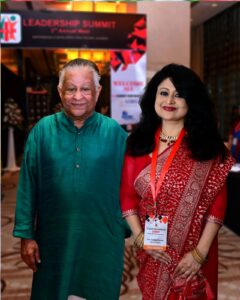
Late Padmashri Dr. K.M. Cherian, Founder Chairman of Frontier Lifeline Hospital
Sandhya Cherian, Vice President, Frontier Lifeline Hospital
You come from a strong healthcare legacy. What core values or philosophies from your first-generation leadership have you carried forward in your journey?
Growing up in the home of Dr. K. M. Cherian, medicine was more than a profession—it was a calling. My father’s life was rooted in service. He always said that healthcare is not a privilege, it is a responsibility. I carry that philosophy with me every day. He performed many free and concessional surgeries because he truly believed that no one should be denied care due to financial hardship. That kind of compassion—genuine, quiet and unwavering left a deep impression on me.
Though I was not allowed to pursue medicine myself, becoming a biomedical engineer and later stepping into Administration, allowed me to contribute in my own way. What I hold on to the most, is his integrity and humility. Even as a world-renowned surgeon, he treated everyone with respect—whether it was a patient in need, or a junior staff member. I try to carry that forward, not just in what I do, but in how I lead.
What were the biggest challenges you faced stepping into a leadership role in a legacy business, and how did you overcome them?
Taking on a leadership role at Frontier Lifeline came with both pride and pressure. My father built something incredible—pioneering cardiac care in the country with extraordinary dedication. It is not easy to follow in the footsteps of someone so accomplished. For me, the biggest challenge was not just trying to sustain what he built, but finding my own voice, while still honouring his.
I did not come in as a doctor. I came in as a Biomedical engineer, with a background in Hospital Administration, and more importantly, as someone determined to preserve the soul of the Institution. It took time to build trust—not just with the team, but within myself. I made it a point to listen to feedback of patients, nurses, technicians and doctors. Being present, approachable, and transparent helped create a culture where people felt seen and heard.
I focused on strengthening the administrative side—streamlining operations, improving coordination, without compromising on patient care, while my brother, Dr. Sanjay, looked into improving the clinical outcomes of patients. What matters most is to be able to lead with clarity, compassion, and consistency.
How have you introduced innovation or transformation into the business while maintaining its foundational identity?
Any change we bring in starts with a simple question: will this help us care better?
We are trying to make meaningful shifts by upgrading our digital systems, improving how we manage patient records, and bringing in better coordination between departments. Our improvements are about freeing up time so that our clinicians can focus on what matters most—patients. We would like to expand our focus beyond just cardiac care to include related specialities so that we can offer more comprehensive solutions without losing our foundational identity.
But no matter what we do, the guiding principle remains the same – the patient is at the centre, and compassion must never be compromised. That is the heartbeat of my father’s legacy, and it continues to guide us forward.
In your view, how is the healthcare industry evolving, and what role do you see your generation playing in shaping its future?
Healthcare is evolving rapidly—digitization, telemedicine, precision diagnostics—they are all changing how we operate. But amidst all the buzzwords, I think we are also facing a quiet crisis, the risk of losing the human connection. Our generation sits at an important intersection. We understand both legacy and innovation. That gives us a chance to be thoughtful architects of what comes next and we should embrace new tools.
I believe our role is to carry forward what the generation before us stood for—ethics, empathy, excellence—but to make it relevant in a new world. It is not either/or. It is both.
Looking ahead, how do you plan to expand or diversify the legacy you’ve inherited? What message would you like to give to future generations of healthcare entrepreneurs?
For us, growth is not about numbers—it is about impact. We would like to expand and find ways to bring quality healthcare to people who do not have access to it. Another area that was very close to my father’s heart was research. He believed deeply in innovation that was rooted in patient needs and real-world applications. One of the areas that my brother and I hope to carry forward is his interest in developing indigenous products—from bovine and porcine valves to shark fin-based products—that could make treatment more affordable.
Continuing his legacy for us, is not just about preserving what he built—it is about carrying forward the love, generosity, and purpose that defined him. His belief that no one should be turned away because they could not afford care is something I will never let go of.
To the next generation: Use every tool at your disposal, but do not forget to be human. Lead with empathy. That is what patient’s need most.
