

2nd Generation Leaders in Healthcare – HOSMAC India Pvt. Ltd.
Passing the Torch: A Legacy Reinvented by the Next GenerationDr. Vivek Desai, Founder & Managing Director, HOSMAC India Pvt. Ltd. Ar. Mihir Desai, Director, M.Sc. TU Munich, Germany, HOSMAC India Pvt. Ltd. Ar. Ishan Desai, Director, (Computational

Passing the Torch: A Legacy Reinvented by the Next Generation
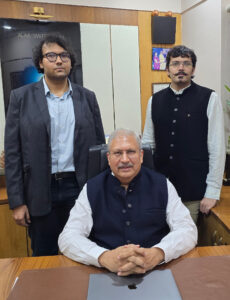
Dr. Vivek Desai, Founder & Managing Director, HOSMAC India Pvt. Ltd.
Ar. Mihir Desai, Director, M.Sc. TU Munich, Germany, HOSMAC India Pvt. Ltd.
Ar. Ishan Desai, Director, (Computational Architect), HOSMAC India Pvt. Ltd.
What emotions or reflections do you have about passing the entrepreneurial torch to the next generation in your family? What emotions or reflections do you have about passing the entrepreneurial torch to the next generation in your family?
Passing the entrepreneurial torch to the next generation in my family is both an emotional milestone and a deeply reflective experience. There’s immense satisfaction in seeing the next generation step into the arena, not just to inherit, but to innovate, to challenge the status quo, and to redefine the path ahead in their own voice.
When I look back, I see years filled with hard choices, long nights, and moments of doubt, but also breakthroughs, relationships, and the quiet joy of building something that matters. To know that this journey has created not just a business, but a platform for future generations to grow from.
Of course, the landscape they are stepping into is vastly different. It’s faster, more complex, and relentlessly global. But the essence of entrepreneurship remains unchanged; it’s about solving real problems, creating meaningful value, and doing so with integrity. That’s the core, I hope they never lose sight of.
How do you feel about your second-generation successor taking over your entrepreneurial legacy?
Over the years, we’ve translated complex clinical requirements into functional, human-centric spaces, often under demanding regulatory and logistical conditions. To now watch the next generation embrace this responsibility, with a fresh perspective, digital fluency, and a genuine commitment to impact, fills me with pride. They’re not simply continuing a legacy; they’re reimagining it for a world that’s changing rapidly.
Naturally, there’s been a shift in my role, from being at the helm to becoming more of a mentor, a sounding board. And I welcome that shift. Legacy, after all, isn’t about preserving the past; it’s about empowering the future. And in that sense, I couldn’t be more optimistic.
You come from a strong healthcare legacy—what core values or philosophies from your first-generation leadership have you carried forward in your journey?
Coming from a strong healthcare legacy, I’ve always felt that my role is not just to expand the business, but to safeguard the principles that defined its inception. The first generation has to set a high bar in terms of both performance and purpose. One of the core values I’ve carried forward is purpose-driven design. Every layout, every circulation plan, every patient touchpoint must serve real clinical and human needs. Equally important is integrity in execution. In hospital infrastructure, there are no shortcuts. Every square foot we design impacts a life, a caregiver, and a clinical outcome.
And finally, I believe deeply in the value of collaborative leadership. We have built enduring relationships with hospital leaders, architects, engineers, and policymakers. I’ve tried to nurture and expand that ecosystem while also bringing in new voices from digital health innovators, sustainability experts, and global consultants. The tools may change, but the compass remains steady.
What were the biggest challenges you faced stepping into a leadership role in a legacy business, and how did you overcome them?
Stepping into a leadership role within a legacy oriented healthcare consultancy brought with it a unique mix of responsibility and scrutiny. The foundation laid by the seniors in the firm is incredibly strong, built on values, long-standing client relationships, and a reputation for integrity and excellence. One of the most personal and significant hurdles was earning trust, not just in the marketplace, but within the organisation itself. Many of our senior team members have been with us for well over a decade; they’ve seen the company grow from its early days. Establishing myself as a credible leader in their eyes took time. I made it a point to listen more than I spoke in those early days, understanding the systems, the unwritten norms, and the culture they had helped shape.
Another major challenge was adapting to the seismic shifts in the healthcare ecosystem, where expectations were no longer limited to just design and compliance, they extended to strategic foresight. To meet that moment, I invested in continuous learning, both for myself and for the organisation. We brought in cross-disciplinary talent, forged new partnerships, and expanded our services to include strategic advisory, digital health integration, and turnkey hospital planning.
How have you introduced innovation or transformation into the business while maintaining its foundational identity?
My approach to transformation has always been anchored in our core competence, i.e., medical planning. That foundation gave us the credibility to push boundaries without losing the trust we’d built over decades. One of the first shifts I introduced was a move toward data-driven, evidence-based planning. We moved beyond conventional layouts and began mapping clinical workflows with greater precision, designing spaces that actively support better patient outcomes and improved staff efficiency. We also embraced digital tools to elevate how we collaborate and communicate. By integrating 3D visualization, BIM coordination, and real-time design feedback systems, we enabled stakeholders, hospital promoters and clinical heads, to engage more meaningfully in the planning process.
Perhaps one of the most defining transformations came post-pandemic, when the importance of flexibility in healthcare design became indisputable. We began embedding modularity and future-readiness into our planning ethos, designing hospitals that could scale rapidly, isolate zones, or repurpose departments with minimal structural intervention.
In your view, how is the healthcare industry evolving, and what role do you see your generation playing in shaping its future?
The healthcare industry is fast transforming beyond clinical care. We’re witnessing a paradigm shift- from hospital-centric models to integrated, decentralized ecosystems. Outpatient centers, digital health platforms, and wellness-oriented community hubs are becoming just as critical as traditional tertiary hospitals. And this evolution demands a new infrastructure and a new mindset.
Medical planning today must incorporate sustainability, technology integration, modularity, and human-centered design. Infection control protocols, telemedicine readiness, and biophilic environments are expectations. Moreover, resilience, adaptability, and empathy must be embedded into the very DNA of healthcare spaces.
This is where I believe the next generation steps in as bridge-builders. They carry the weight of accumulated practical wisdom, yet they must translate it into a language that resonates with the future. They’re tasked with ensuring that what was built with great intent doesn’t become obsolete, but evolves to remain relevant and forward-looking.
I feel a deep sense of fulfillment in seeing the next generation step into this future with clarity and conviction. Both my sons, trained as architects, bring a refreshing energy. My elder son, with his expertise in campus master planning and healthcare design, is reimagining how institutions function as ecosystems. And my younger son is leveraging AI and digital workflows to dramatically enhance planning efficiency, enabling us to do more with fewer resources, without compromising on quality.
Together, they’re crafting new possibilities. And I’m confident that their contributions will help shape the next chapter of India’s healthcare infrastructure in meaningful, future-facing ways.
Looking ahead, how do you plan to expand or diversify the legacy you’ve inherited—and what message would you like to give to future generations of healthcare entrepreneurs?
Looking ahead, my vision for expanding this legacy is deepening our impact on healthcare delivery itself. As the industry evolves, so too must our role within it. We’re moving beyond the scope of individual hospital projects to conceptualize entire healthcare ecosystems that are integrated, future-ready, and rooted in community well-being.
To future generations of healthcare entrepreneurs, my message is simple- always remember that healthcare is not just a business, it’s a responsibility for a social cause, and earning money is incidental. The buildings and businesses we plan, the systems we design must stand for decades to serve humanity. One must bear in mind to lead with integrity, design with empathy, and stay rooted in the fundamentals, even as you embrace change. Technology will evolve, tools will transform, but the core mission, i.e., to create spaces that heal, will remain.
