
2nd Generation Leaders in Healthcare – J Mitra & Co
Indian diagnostics companies often struggle with international regulatory pathwaysJatin Mahajan, Secretary, Association of Diagnostics Manufacturers of India (ADMI) Managing Director, J Mitra & CoLalit Mahajan, Chairman - J Mitra & CoYou come from a strong healthcare

Indian diagnostics companies often struggle with international regulatory pathways
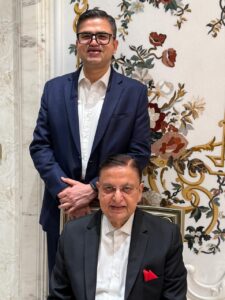
Jatin Mahajan, Secretary, Association of Diagnostics Manufacturers
of India (ADMI) Managing Director, J Mitra & Co
Lalit Mahajan, Chairman – J Mitra & Co
You come from a strong healthcare legacy—what core values or philosophies from your first-generation leadership have you carried forward in your journey?
of India (ADMI) Managing Director, J Mitra & Co
At J Mitra & Company, we are rooted in a philosophy that healthcare is not just a business; it is a social responsibility. This was the principle that my father Shri Lalit Mahajan imbibed in me that forms the foundation of my character. My father has an unwavering focus on quality and innovation-driven affordability, which has been the primary reason for the trust enjoyed by the company. This philosophy of ‘science with purpose’ is something I have wholeheartedly embraced in my quest to develop reliable, high-quality, and cost-effective diagnostic solutions that serve both rural India and global markets.
From day one, my father taught me that integrity in business is non-negotiable. He pioneered the IVD space in India with patented, indigenous technologies at a time when multinational imports dominated the market. His belief in “Make in India” long before it became a policy mantra is a virtue I’ve deeply internalized. Equally important was his relentless focus on R&D, which led to J Mitra becoming India’s most patented diagnostics company.
Today, while I introduce digital transformation and global market expansion, the foundational ethos of affordability, accessibility, and accuracy continues to guide every step we take.
What were the biggest challenges you faced stepping into a leadership role in a legacy business, and how did you overcome them?
Stepping into a legacy business with such a storied reputation brings with it immense pressure, not only to maintain standards but also to raise the bar. The biggest challenge was balancing reverence for our legacy with the need for modernization. J Mitra had already established itself as a pioneer in diagnostics, but with shifting technologies, regulatory frameworks, and global competition, I had to reimagine how we could stay ahead.
There was also the generational challenge of aligning traditional, process-oriented operations with newer, data-driven models. Introducing automation, ERP systems, and AI-based analytics in a legacy manufacturing setup meant convincing long-serving teams to embrace change without feeling alienated. I overcame this by building trust and demonstrating how tech-enabled systems enhance our core mission rather than replace it.
Another hurdle was global scalability. Indian diagnostics companies often struggle with international regulatory pathways. We invested in obtaining international certifications, such as CE, US FDA, and WHO prequalification, and nurtured partnerships to establish our presence in over 45 countries.
Through my journey, I’ve learned that leadership in a legacy business is about evolution, not revolution—respecting the past, responding to the present, and reshaping the future with vision and empathy.
How have you introduced innovation or transformation into the business while maintaining its foundational identity?
Our transformation journey at J Mitra has been anchored in our commitment to innovation with impact. While my father built the foundation of India’s diagnostics ecosystem with pathbreaking R&D and indigenous manufacturing, I’ve focused on digitization, global expansion, and product diversification—always ensuring that our core purpose of saving lives through early diagnosis remains unchanged.
One of the key innovations has been the integration of AI and data analytics in product performance monitoring. We’ve also upgraded our R&D infrastructure to support molecular diagnostics, point-of-care testing, and newer platforms like CLIA, enabling faster, more accurate results in field settings.
We have introduced highly automated and digital manufacturing and quality control systems to make the entire manufacturing process agile and eliminate any chance of human error and fatigue, thereby ensuring that only the very best products are shipped from the manufacturing plant. This has not only increased our productivity but also brought us closer to meeting our compliances in this heavily regulated industry.
We’ve also expanded access by designing a portable diagnostic solution – iQuant – suited for India’s rural healthcare landscape and low-resource settings in Africa and Latin America, echoing the company’s founding mission.
Ultimately, innovation is not about replacing legacy, but it is about renewing its relevance. Every new step we take is guided by the same principles that built J Mitra: reliability, affordability, and service to public health.
In your view, how is the healthcare industry evolving, and what role do you see your generation playing in shaping its future?
The healthcare industry is undergoing a significant shift—from reactive care to preventive and predictive healthcare. With the rise of digital health, AI-based diagnostics, telemedicine, and personalized medicine, the role of diagnostics has moved from the background to the frontline of disease management. Our generation must lead this transformation with boldness and responsibility.
India, with its demographic diversity and strong scientific base, is poised to emerge as a global health-tech hub. However, to achieve this, we must ensure that R&D and commercialization go hand in hand, the ease of doing business in India needs to be enhanced, and regulatory bottlenecks are eliminated. As a second-generation entrepreneur, I see our role as ecosystem builders—investing not just in technology but in skilling, research collaborations, and policy advocacy.
For our generation, the responsibility is twofold – we must drive innovation and simultaneously ensure inclusivity. When we inherit a company, we also inherit the public trust associated with it. We must create a healthcare ecosystem that is sustainable, equitable, and globally relevant.
Looking ahead, how do you plan to expand or diversify the legacy you’ve inherited—and what message would you like to give to future generations of healthcare entrepreneurs?
The future of J Mitra lies beyond being India’s diagnostics leader to being a global MedTech powerhouse. We are currently investing in three key verticals: CLIA, molecular diagnostics, and international expansion, with a focus on Latin America, Southeast Asia, and Africa. Our roadmap includes newer rapid tests for non-communicable diseases and home-based diagnostic kits, which will drive decentralized healthcare.
We are also exploring research partnerships with biotech firms to drive innovation. The next generation of healthcare entrepreneurs must ensure that innovation serves people, not just markets. They have to be fearless in their ambition but grounded in purpose. This industry is not about valuations alone but about the value we create for society.
Legacy is not just something you inherit—it’s something you reimagine. My father established J Mitra to serve lives through science. My job is to amplify that impact with the tools of today and the vision of tomorrow.
