
Experts at IHW Cancer Summit Welcome Budget Waiver on Customs Duty for Cancer Drugs, advocate momentum must continued for universal access
The 7th Cancer Summit & Awards 2026, organised by the IntegratedHealth & Wellbeing (IHW) Council today in New Delhi, brought together a powerful cross-section ofIndia’s cancer ecosystem on the eve of World Cancer Day. The
The 7th Cancer Summit & Awards 2026, organised by the Integrated
Health & Wellbeing (IHW) Council today in New Delhi, brought together a powerful cross-section of
India’s cancer ecosystem on the eve of World Cancer Day. The conclave convened clinicians,
policymakers, industry leaders, researchers, patient advocates and civil society to deliberate on how
India can move towards more equitable, affordable and technology-enabled cancer care.
This dialogue comes at a critical time, as per ICMR’s National Cancer Registry estimates, India recorded
over 15.3 lakh new cancer cases in 2024 and around 8–8.7 lakh deaths, against a global burden of 20
million new cases and 9.7 million deaths in 2022, underscoring the urgent need for earlier detection,
wider access to care and stronger cancer systems, especially in low- and middle-income countries.
Through the day, focused sessions explored multiple dimensions of oncology in India. A high-powered
panel on “Clinical & Technology Innovation” discussed advances in diagnostics, precision medicine,
imaging and integrated genomics, and how these can be translated into wider access in both public and
private settings. A dedicated industry presentation showcased how integrated oncogenomics can help
navigate tumour heterogeneity and support more personalised treatment decisions.
In his welcome address, Kamal Narayan Omer, Founder & CEO, IHW Council, set the context for the
summit and underlined the need for collective, system-wide action against cancer. “Meeting on the eve
of World Cancer Day reminds us that India’s response to cancer must be urgent, coordinated and
patient‑centred. This summit was started to keep cancer at the heart of public and policy dialogue, not
confined to hospitals alone. Recent steps like customs duty exemptions on life‑saving cancer drugs and
the Biopharma Shakti initiative show strong intent to improve access, affordability and indigenous
innovation. Yet many of our 15 lakh annual cancer cases are detected late. Our aim is to bring all
stakeholders together so that preventable and treatable cancers are neither missed nor denied care.”
Mr. Amit Kumar Ghosh, Additional Chief Secretary, Medical Health & Family Welfare and Medical
Education, Government of Uttar Pradesh, delivered the keynote address and underscored the need to
translate higher health investments into stronger cancer systems. He voiced, “India’s health sector is at
a defining moment, with the Union Health Budget crossing ₹1 lakh crore for the first time and firmly
positioning healthcare as a driver of economic growth, social equity and the India@2047 vision. In Uttar
Pradesh, we have expanded government medical colleges from 9 to 43 and are shifting from episodic to
system‑driven, preventive and technology‑enabled care. Through initiatives such as Ayushman Bharat,
population-based screening, new cancer institutes in Lucknow and planned cancer day-care centres
across the state, our focus is on early detection, timely referral and affordable treatment. Going forward,
stronger public–private collaboration and patient‑centric policies will be key to reaching the last mile.”
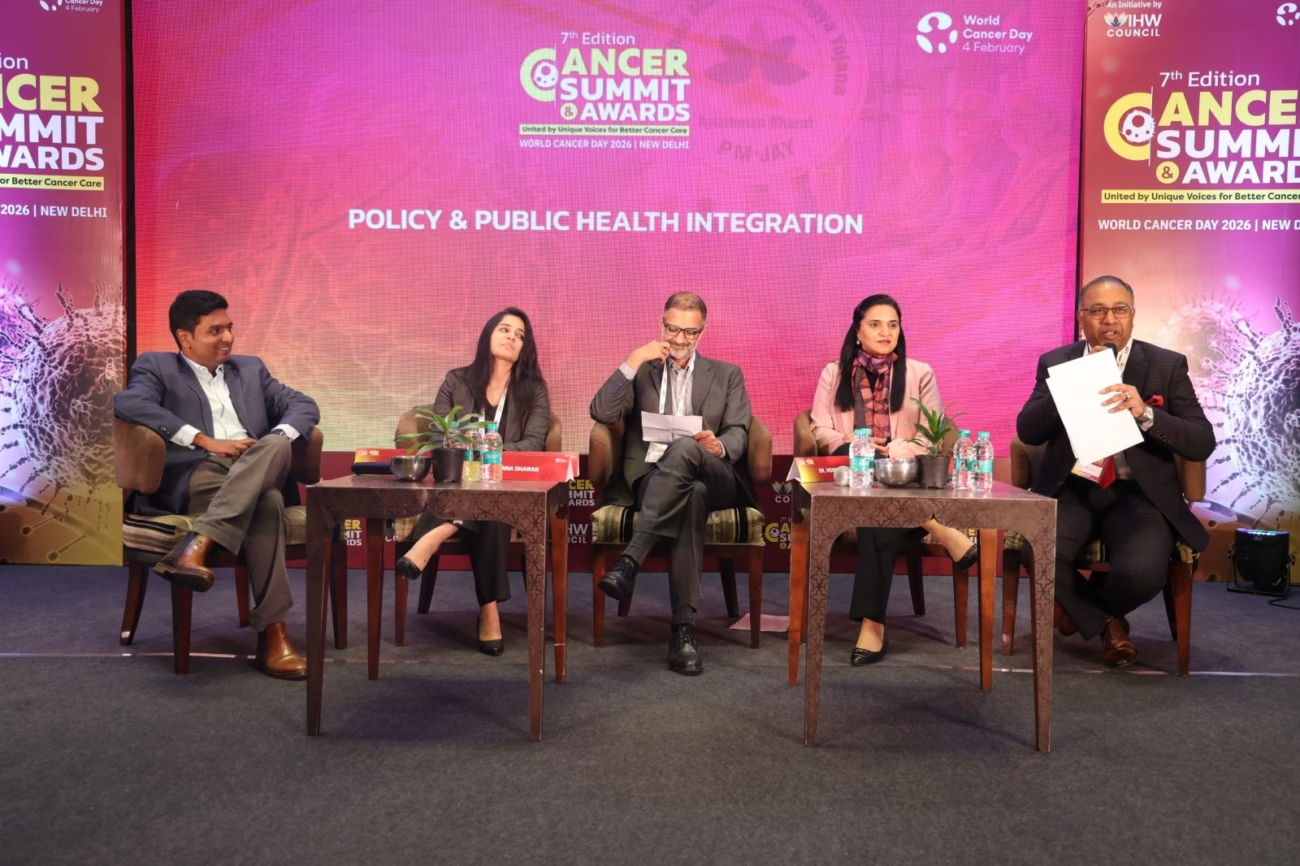
The second half of the summit shifted focus to systems, policy and people, with sessions on research,
capacity building and collaboration to build a sustainable oncology ecosystem through training,
multidisciplinary teams, partnerships and regional cancer centres. It also explored how Ayushman
Bharat and other national schemes can embed cancer prevention, screening, treatment and financial
protection into mainstream public health. Discussions on equity and patient-centric care tackled late
diagnosis, geographic gaps, costs and psychosocial support, while a digital oncology panel highlighted
tele-oncology, AI and data-driven models. The day closed with a flagship patient–policy dialogue and an
awards ceremony honouring leaders in cancer control.
Held just ahead of World Cancer Day, the 7th Cancer Summit & Awards 2026 reinforced the message
that defeating cancer in India will require sustained collaboration between government, healthcare
providers, industry, academia and communities, and that platforms like this summit are critical to
aligning intent, innovation and impact.