
India MedTech Industry Growth Piyush Goyal Highlights Innovation & Atmanirbhar Bharat Vision at 17th CII Global MedTech Summit 2025
“For a Viksit Bharat by 2047, India cannot limit itself to modest goals: The MedTech sector is a natural candidate for Atmanirbharata,” said Shri Piyush Goyal, Hon’ble Minister of Commerce and Industry at the 17th

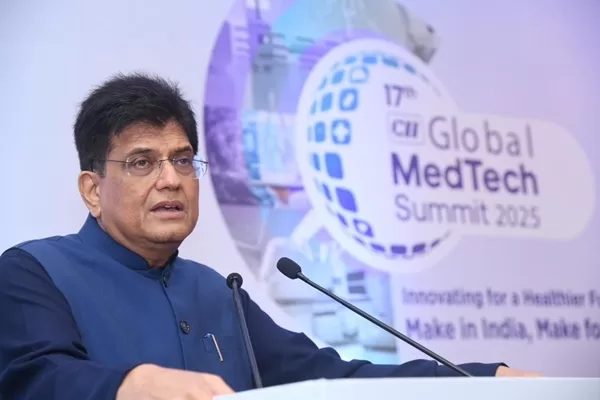
“For a Viksit Bharat by 2047, India cannot limit itself to modest goals: The MedTech sector is a natural candidate for Atmanirbharata,” said Shri Piyush Goyal, Hon’ble Minister of Commerce and Industry at the 17th CII Global MedTech Summit 2025
“The theme ‘Innovating for a Healthier Future – Advancing MedTech for Global Impact: Make in India, Make for the World’ aptly captures India’s aspirations and the world’s expectations from us. For a Viksit Bharat by 2047, we all need to relook at our plans, ability to collaborate within the country and outside, become bigger and bolder, and aim for the sky. India cannot limit itself to modest goals, and the MedTech sector is a natural candidate for Atmanirbharata and self-reliance”, said Shri Piyush Goyal, Hon’ble Minister of Commerce & Industry, Government of India.
Shri Piyush Goyal was speaking at the 17th CII Global MedTech Summit 2025 in New Delhi today. He further elaborated on the sector’s potential: “India and its people rose together amidst the COVID pandemic, with the world recognizing India as the ‘Pharmacy of the World’. There is huge potential for the MedTech industry to grow at scale by relooking at its plans with the bolder challenges.”
He underscored that the India-EFTA USD 100 billion FDI commitment could be utilized with India emerging as a reliable partner. Similar such partnerships will open new opportunities, investment possibilities to bring scale, quality, and innovation into India. He mentioned that the entire sector can be transformed, provided one comes forward with participation in innovation and R&D.
He added, “At the government level, we are taking measures to make it easier to do business, promote industry to ensure they’re able to capture relevant opportunities, while ensuring availability of high-quality healthcare throughout the country at affordable prices.”
He noted that we need to look at improvements in our IPR regime to bring in relevant investments into India and technology into India. Positioning India as a source of innovation and R&D will happen when the industry grabs this opportunity.
Shri Goyal concluded by highlighting that Import Substitution should be looked at wherever possible, either through technological collaborations or R&D, and greater self-reliance, ensuring resilient supply chains. Additionally, need to build stronger export markets, with competitive products and a strong ecosystem.
“MedTech is at the heart of the enterprise – the human being, the patient, and human healthcare. For this industry, scale is not a problem; imagination is. India, home to the largest population with decades of growth and rising purchasing power, must look to the future, take risks, and prepare. That’s what innovators do. Entrepreneurs and the government both have an important role to play in the growth of an ecosystem,” said Shri Amit Agrawal, Secretary, Department of Pharmaceuticals, Ministry of Chemicals & Fertilizers, Government of India
He underscored that the growth of the sector was unimaginable before the pandemic, and today India produces linear accelerators, cobalt machines, MRI & CT Scan machines, ventilators, dialysis machines, etc. Once the domestic manufacturing capabilities are seeded into the ecosystem, coupled with the increasing purchasing power and availability of public healthcare, the sector will grow rapidly. India’s unique strength lies in ICT & innovation, backed by a large, entrepreneurial workforce. With a large task force and an innovative, entrepreneurial ecosystem, India is naturally positioned to lead.
He concluded by adding, “We need to invert our mission; solving the scale problem means working at every stage of the value chain with every stakeholder within India and outside.”
“The addition of Ayushman Bharat, Government schemes of CGHS, CCHS, and now the growth of private insurance has brought millions of people into the safety net of healthcare delivery,” said Dr Naresh Trehan, Chairman, CII Steering Group on Health and CII Healthcare Council; Chairman and Managing Director, Medanta-Medicity
“This is the decade for MedTech, but we must transform ourselves as innovators, as per what the providers and patients need. The government has been supportive, but our productivity is lacking. We need to bring into the loop all the young demographic opportunities to compete with the world,” he added.
He further reiterated, “We should get away from doing everything ourselves and build our relationships, leverage the huge resources we have in our IITs, support from the Government, capital etc. to build the ecosystem.
He concluded by adding that dialogue on day-to-day problems between industry and government should be streamlined. The MedTech industry has a new opportunity, with both catching up and leapfrogging happening simultaneously. Industry needs to come together to address the real difficulties and further deliver the finest MedTech across the spectrum.
“Indian patients deserve what innovation can bring to them in terms of accessibility, affordability, and experiencing care. India’s MedTech space is in a transformative journey, which needs to be made smooth,” said Mr Shishir Agarwal, Chairman, CII National Medical Technology Forum and President & Managing Director, Terumo India.
He added that India has a rising disease burden, economic disparities, but healthcare should be uniform for everyone, no matter the geography. The last 10 years have seen significant transformation, with a reduction in medical Out-Of-Pocket expenses, Ayushman Card with 350 million registered patients, and digital transformation.
Underscoring the government support over the years, he added, “From Ayushman Bharat to PLIs to MedTech manufacturing zones to R&D in incentives, there has been a push to create capacity in the country and a robust ecosystem that can help the world.”
Mr Agarwal also noted that India has moved from being a consumer of MedTech to becoming a creator and collaborator for MedTech and the cusp of being a global catalyst. “‘Make in India, Make for the World’ is not just a slogan, but calls for a strategy to be built on scale, skill, and sovereignty.
“We are at a defining moment in terms of India’s healthcare; while we have come a long way in the healthcare delivery system, the next phase is all about scaling up the impact of healthcare with a deepened value chain and moving faster,” said Mr Hariharan Subramaniam, Co-Chairman, CII National Medical Technology Forum & Managing Director, Siemens Healthcare Private Limited
“We have made remarkable progress in the past decade with MedTech growing rapidly, powered by the vision of entrepreneurs, world-class clinicians, research capabilities, and, most importantly, the Government’s role from being a healthcare provider to a healthcare facilitator, addressing the gaps in healthcare access and funding.
He noted, “We still have some distance to cover to become strong and self-sufficient in the MedTech space, especially in advanced devices. The market in India for high-end equipment, while growing, is still limited in scale. He added that ‘Ease of doing business’ needs to be further enhanced to support the mission of ‘Make in India, Make for the World’ for the MedTech industry.
“When we talk about MedTech, AI stands for Academia-Industry collaboration. Innovation, equity, and collaboration are central to redefining healthcare delivery,” said Mr Gaurav Agarwal, Co-Chairman, CII National Medical Technology Forum & Managing Director, Innvolution Healthcare Pvt Ltd
He also noted, “Today, MedTech delivery can only succeed if it is accessible, affordable, and available. The industry has scaled up from under USD 4 billion in 2015 to USD 16 billion by last year, a fourfold growth with a potential to grow to USD 50 billion industry by Viksit Bharat at 2047.”
He also reiterated that the growth of the sector is visible from trade figures: with imports in the sector growing at only 8%, but exports growing by 25%, with a focused shift from volume to value. The vision for 2030 includes the domestic MedTech market to reach INR 25 Crores and attract USD 15 billion in international investment with a focused roadmap.