
Rajiv Gandhi Cancer Institute & Research Centre, Rohini, New Delhi Launches ‘Two Minute Action for Oral Cancer Protection’
Gutkha, other forms of chewable tobacco, smoking, alcohol, poor oral hygiene, dental infections and viral infections (HPV) are major risk factors behind the growing number of oral cancers in India. In a timely and impactful

Gutkha, other forms of chewable tobacco, smoking, alcohol, poor oral hygiene, dental infections and viral infections (HPV) are major risk factors behind the growing number of oral cancers in India.
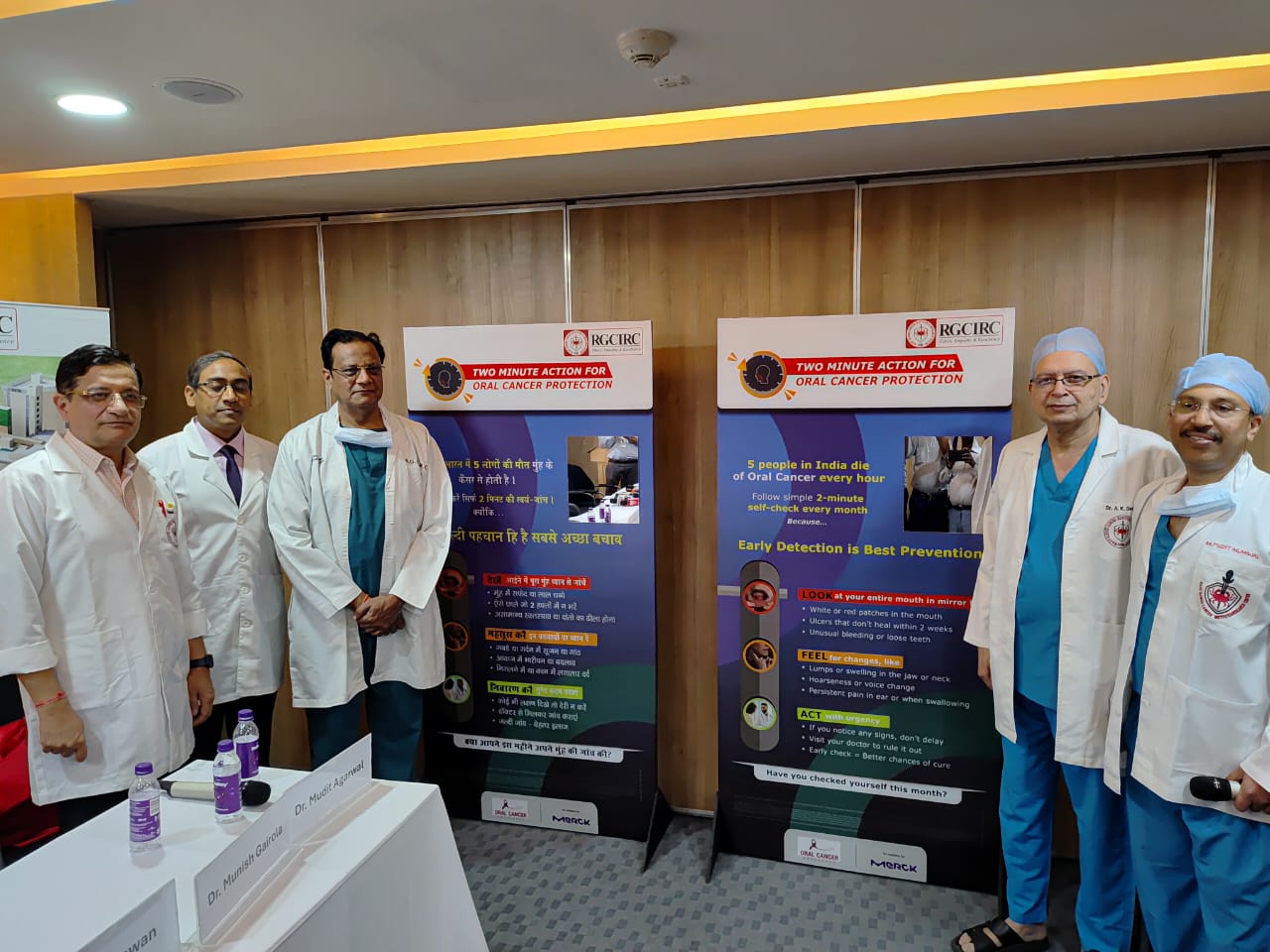
In a timely and impactful initiative, Rajiv Gandhi Cancer Institute & Research Centre, Rohini, New Delhi, in association with Merck Specialities Private Limited has launched the “Two-Minute Action for Oral Cancer Protection” campaign with the hashtag #ActAgainstOralCancer.
At the campaign launch, Dr. Rajat Saha, Senior Consultant & Unit Head – Medical Oncology, introduced the esteemed panel comprising senior faculty from RGCIRC, which included Dr. Sudhir Kumar Rawal, Medical Director and Chief of Genito-Uro Oncology, Dr. A.K. Dewan, Director – Surgical Oncology, Dr. Munish Gairola, Director – Radiation Oncology, and Dr. Mudit Agarwal, Unit Head & Senior Consultant – Head & Neck Surgical Oncology.
This nationwide effort aims to tackle the alarming rise in oral cancer cases by encouraging individuals to perform a quick self-check using mirrors that are almost always available to one and all. The message is clear: Look, Feel and Act. Early detection through a quick mirror check can make all the difference between timely treatment and a missed opportunity. By turning mirrors into tools of awareness, the experts are empowering individuals to take charge of their health in just two minutes because early action can help diagnose cancers at an early stage. Through this initiative, patients who are visiting hospitals can also activate this self- check-up where mirrors will be strategically placed in the hospital waiting areas. The same message of self-examination should be implemented in a chain fashion at every home, office , school etc.
Emphasizing on the prevalence of cancers, Dr. (Prof) Sudhir Kumar Rawal – Medical Director, RGCIRC highlighted, “Head and neck cancer is very common in India. This type of cancers are lifestyle-related, linked to rampant use of tobacco and alcohol in the society. The treatment of this cancer, especially when detected early, is much more effective.”
India is the world’s capital of Head and neck cancer. Every year, around 2 lakh patients are newly diagnosed with Head and neck cancer, which is the highest compared to any other country. In 2022, simply the number of Lip and oral cavity cancer cases were more than a lakh (65%). Adding the rest of the head and neck cancer sub-sites, the numbers will be nothing less than 20-25% of the total male cancers in our country. Unfortunately, in India, around 60 to 70% of patients already have advanced disease (stage 3-4) at the time of diagnosis.
Dr. A. K. Dewan – Director, Surgical Oncology, RGCIRC further explained about advancement in cancer treatments and radiotherapy. “Over the past 40 years, cancer treatment has transformed greatly. In the 1980s, we relied on basic X-ray-based radiotherapy and unimodal treatments, with limited surgical reconstruction. Nowadays we have access to Plastic surgery, which was then not developed, and wounds took months to heal. Today, we use 3D reconstruction, plastic surgery, chemotherapy, immunotherapy, and advanced radiation techniques. So, treatment is now multi-modal (all methods of treatment), focusing on when and how to use each method or when to withhold them based on the patient’s condition. Our primary focus is on improving the quality of life of the patient and not just curing the disease.”
Dr. A.K. Dewan further added,” Gutkha, smoking, alcohol consumption, poor oral hygiene, and certain viral infections, especially Human Papillomavirus (HPV) are key risk factors contributing to the rising incidence of throat cancers. The HPV virus related throat cancers, once considered rare, are now increasingly seen in youngsters due to frequent adoption of oral sex. While India currently reports fewer cases compared to Western countries, where there is a noticeable spike, particularly in tonsil cancers. Some countries have recommended HPV vaccine for children aged 12-15 to prevent HPV virus related tonsil cancer.”
“If cancer returns, we start with chemotherapy. But today, immunotherapy has made major strides. It’s now used alongside chemotherapy to boost the body’s own immune system, helping it recognize and fight cancer more effectively. This approach is not only more targeted but also comes with fewer side effects than traditional chemotherapy, making it a more patient-friendly option. There have been significant advancements, including targeted therapies both in the form of tablets and injections that focus specifically on cancer cells. However, in India, where cancer is more prevalent among the lower socioeconomic class, treatment affordability remains a challenge. That’s why several trials are underway to explore whether lower doses of these advanced medicines can still be effective and accessible,” underscored Dr. Rajat Saha – Senior Consultant & Unit Head, Medical Oncology, RGCIRC.
“Most patients need a combination of surgery, radiation, and chemotherapy. Radiation therapy, especially in head and neck cancers, plays a crucial role. If surgery isn’t possible, we use radical radiation as a cost-effective option. Even after surgery, radiation is often needed. For patients who can’t be cured, we offer palliative radiotherapy to improve their quality of life. Modern radiation therapy has reduced side effects considerably,” said Dr. Munish Gairola – Director, Radiation Oncology, RGCIRC.
“Chewing betel leaves and supari has long been a social custom in parts of India, but over time, it has led to serious health risks, including cancer, especially when combined with smoking and alcohol. Adding tobacco and slaked lime to paan increases irritation and speeds up nicotine absorption, making it even more harmful. Chronic irritation due to sharp teeth, ill fitting dentures are also contributing to oral cancers. There should be awareness on the common early signs and symptoms of oral cancers like white patches, red patches, referred ear pain and non healing ulcers.,” concluded Dr. Mudit Agarwal – Unit Head & Senior Consultant, Head & Neck Oncology, RGCIRC.
The rising surge in oral cancer cases is an urgent call for creating immediate public awareness on early detection and preventive action. The causes of oral cancer include tobacco use, excessive alcohol consumption, and Human Papilloma Virus (HPV) infection. Oral cancer becomes difficult to treat and is often not preventable in later stages due to delayed diagnosis. Early detection through regular self-checks is key to improving outcomes and helps prevent complications. Complications of oral cancer can include difficulty in speaking, swallowing, and breathing, as well as the spread of cancer to nearby tissues or other parts of the body. “Two-Minute Action for Oral Cancer Protection” campaign will help with timely detection and early referral for oral cancers.