
World’s First Per Oral Endoscopic Myotomy (POEM) Performed On Canine
4-Year-Old Labrador with Swallowing Disorder Successfully Undergoes POEM Procedure, Recovers Well Pioneering minimally invasive surgery brings new hope for pets suffering from life-threatening esophageal disordersIn a historic first for veterinary surgery, The Small Animal Clinic, Pune, has

4-Year-Old Labrador with Swallowing Disorder Successfully Undergoes POEM Procedure, Recovers Well
Pioneering minimally invasive surgery brings new hope for pets suffering from life-threatening esophageal disorders
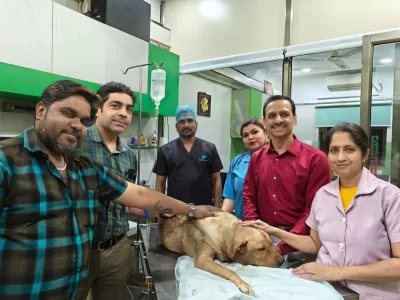
In a historic first for veterinary surgery, The Small Animal Clinic, Pune, has successfully performed the World’s first Peroral Endoscopic Myotomy (POEM) procedure on a canine patient. Maggie, a 4-year-old Labrador diagnosed with megaesophagus, a severe swallowing disorder, can now eat and live a healthy life again.
The complex procedure was led by Dr. Narendra Pardeshi, Veterinary Surgeon, and Dr. Mandar Doiphode, Gastroenterologist, along with a skilled support team of Mrs. Reena Haribhat, Ankita Dwivedi, Asmi Pardeshi, and technical assistants Mr. Vijay Kamble and Mr. Giriraj Singh.
For the last four months, Maggie’s family watched in distress as she vomited 6–8 times a day, lost nearly 10 kg, and struggled to swallow even the simplest of meals. Detailed investigations revealed megaesophagus linked to achalasia—a rare disorder where the esophagus muscles fail to contract, and the lower esophageal sphincter does not relax, preventing food from entering the stomach.
“Megaesophagus is more common in dogs than cats and can be devastating, leading to malnutrition, aspiration pneumonia, and even death,” explained Dr. Pardeshi. “Earlier, such conditions required open surgery with long recovery periods. The POEM procedure, however, is a game-changer—it is minimally invasive, offers faster recovery, and significantly improves swallowing function.”
To make this breakthrough possible, Dr. Pardeshi trained under leading human gastroenterologists in advanced endoscopic procedures and collaborated closely with Dr. Mandar Doiphode, a human gastroenterologist, during Maggie’s treatment. This rare cross-specialty teamwork ensured the highest precision and safety in performing POEM on a canine for the first time in the world.
During the 3-hour procedure, an endoscope was used to carefully cut the tight esophageal muscles and restore normal passage of food. Unlike traditional surgery, POEM leaves no external scars, relies on real-time video magnification for precision, and ensures a safer outcome for patients.
Maggie was kept under close observation post-surgery, transitioned to a liquid diet, and monitored with X-rays for healing. Within a week, she showed remarkable improvement and is now regaining the weight she lost.
“Maggie is not just our pet—she is family. Watching her suffer every day was unbearable. Thanks to this innovative procedure, we have our playful, happy Maggie back. It feels like a miracle,” said an emotional Shubham Jadhav, Maggie’s pet parent.
Dr. Mandar Doiphode, Gastroenterologist, said, “Achalasia is a complex disorder even in human beings. Diagnosing this condition in a dog is even more difficult. Conventional surgery can lead to many complications and also has a very long recovery period. The POEM procedure has made this surgery scarless and recovery very fast. In this procedure, there was not a single drop of blood shared while doing the procedure because of the advanced surgical procedure. I consider myself really fortunate to have been associated with Dr. Pardeshi, who correctly diagnosed this condition and gave me the opportunity to perform the first POEM procedure in dogs.”
This achievement marks a historic first for veterinary medicine in world, opening up new possibilities for treating complex swallowing disorders in animals. It highlights the growing role of advanced endoscopic techniques in veterinary care, where collaboration between human and veterinary experts is creating new horizons of hope.