
Cancer Patients in India Could Rise to 2 Million by 2040: MoS Dr. Jitendra Singh Highlights Urgent Public Health Challenge
India may face a significant increase in the number of cancer patients over the next decade and a half, with cases projected to rise to nearly 2 million (20 lakh) by 2040, Dr. Jitendra Singh,

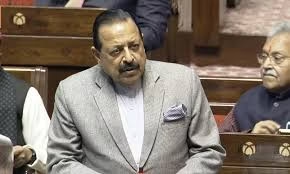
India may face a significant increase in the number of cancer patients over the next decade and a half, with cases projected to rise to nearly 2 million (20 lakh) by 2040, Dr. Jitendra Singh, Minister of State in the Prime Minister’s Office, informed the Rajya Sabha today during the Question Hour.
Speaking in response to supplementary questions in the upper house of Parliament, Dr. Singh noted that India currently has approximately 1.4 to 1.5 million cancer patients, positioning the country third globally in cancer prevalence after China and the United States. If current trends continue, that figure is expected to grow substantially by 2040.
The Minister attributed this rising cancer burden to demographic transitions and changing disease patterns in India. While communicable diseases dominated the health landscape until the 1980s, non communicable diseases, including cancer and heart disease, are now contributing increasingly to morbidity and mortality. He highlighted that many cancers and cardiovascular conditions are now being diagnosed at younger ages than previously observed. ([The Week][2])
Dr. Singh also referenced India’s changing population profile, where an expanding proportion of citizens aged 60 years and above adds to the overall disease burden, even as a large share of the population remains young.
In outlining the government’s efforts, the Minister pointed to an ambitious programme to expand cancer care facilities in nearly every district hospital across the country, ensuring improved access to diagnosis and treatment for patients nationwide. He stressed that the nature and pattern of cancers vary regionally, citing a higher prevalence of head and neck cancers in northeastern states.
On prevention efforts, Dr. Singh informed Parliament that the Department of Biotechnology has developed India’s first indigenous HPV vaccine with a preventive role against cervical cancer, a condition more commonly seen in young women. Discussions are underway with the Ministry of Health to make the vaccine available to larger populations at affordable prices or free of cost.
The Ministry’s statement underscores a critical public health imperative strengthening cancer screening, expanding early detection programmes, enhancing treatment infrastructure, and improving awareness to manage the anticipated rise in cancer cases effectively.