
Reducing Delays, Drop-offs and Distress: Patient Navigation in Focus at Year-EndOncology Meet
At the Year-End Review Meeting in Oncology held in Varanasi (27–28 December 2025), adedicated session on “Patient Navigation – The Fulcrum of Cancer Treatment” broughttogether doctors, researchers, a patient voice, and on-ground support professionals to speakabout a

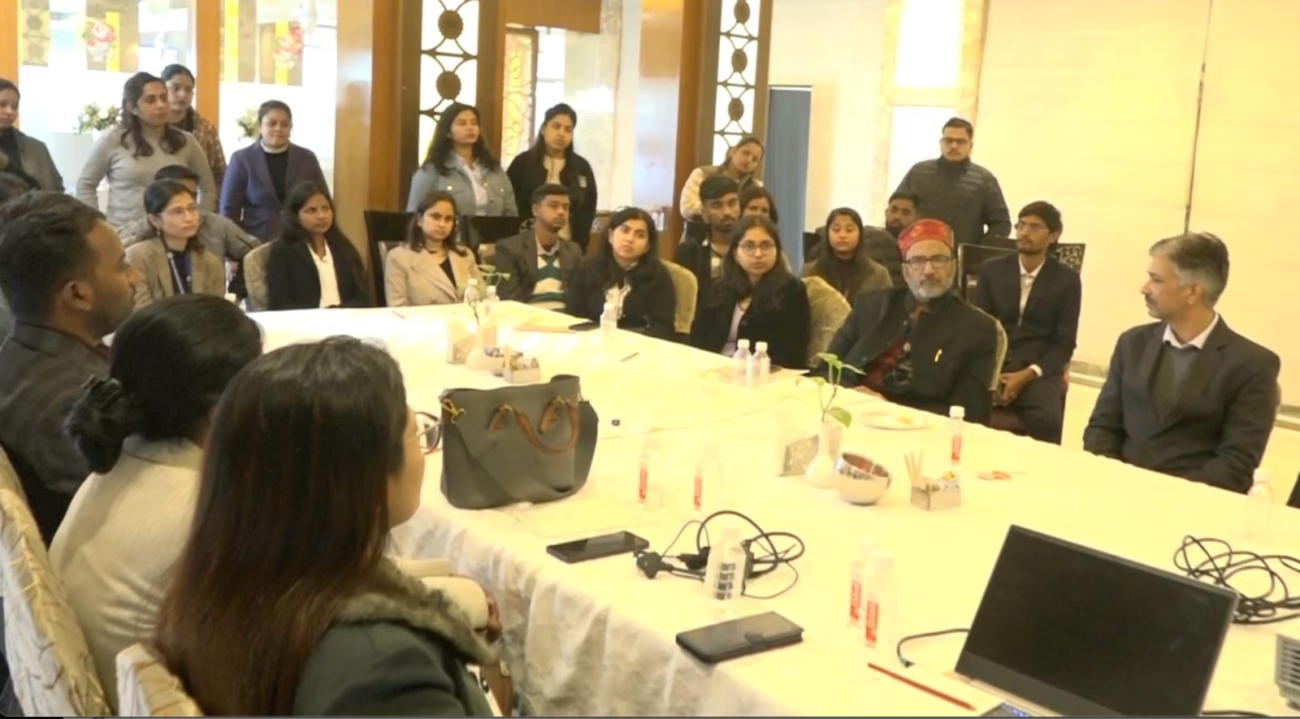
At the Year-End Review Meeting in Oncology held in Varanasi (27–28 December 2025), a
dedicated session on “Patient Navigation – The Fulcrum of Cancer Treatment” brought
together doctors, researchers, a patient voice, and on-ground support professionals to speak
about a simple truth: treatment works best when patients are able to reach it, understand it,
and stay on it.
The meeting was convened under the leadership of Dr Amit Kumar, Medical Oncologist
from Patna.
The panel included Dr Akhil Kapoor, Medical Oncologist and HOD, MPMMCC
Varanasi; Dr. Anuj Gupta, Medical Oncologist, MPMMCC Varanasi, Dr Vikas Talreja,
Medical Oncologist, Regency Hospital Kanpur; Dr Narendra, Research Scientist,
MPMMCC Varanasi; Dr Archi Rungta, Genetic Specialist; Shri Vijay Acharya, who is
living with pancreatic cancer; and Mr Arvind, Medical Social Worker. The session was
moderated by Mr Vivek Sharma, cancer patient advocate and Founder of Uhapo, a patient
support organisation.
Across the discussion, speakers repeatedly returned to what patients and families face beyond
prescriptions—appointments that don’t align, reports that are hard to interpret, long
travel, paperwork, financial uncertainty, fear, fatigue, and the feeling of being lost in the
system. While hospitals work hard to deliver the best clinical care, the panel noted that many
patients struggle with the “between visits” part of cancer treatment—where a missed test, a
delayed referral, or a lack of clarity can snowball into interruptions.
The panel spoke about the current resources available to patients—medical teams, social
work support, patient advocates, and emerging counselling and education efforts—and also
highlighted what still needs strengthening. This included clearer referral pathways, easier-to-
access information in patient-friendly language, practical help with logistics, and stronger
emotional and social support for patients and caregivers.
A key moment of the session came from Shri Vijay Acharya, who shared what it means to
live with pancreatic cancer and navigate the healthcare journey over time. His perspective
reinforced the need for navigation that is not only efficient, but also compassionate—support
that helps patients feel informed, supported, and not judged for their disease or the treatment
in society.
The session closed with a shared view from the panel: patient navigation is not an
“extra”—it is what helps patients stay the course and complete treatment with fewer
avoidable hurdles. Strengthening navigation, the group agreed, can reduce delays, ease
distress, and improve the overall experience and outcomes for people affected by cancer.