
India UK CETA Opens New Growth Avenue for India’s Healthcare and MedTech Industry
The implementation of the India United Kingdom Comprehensive Economic and Trade Agreement (CETA) marks a significant milestone in bilateral economic relations, creating new opportunities for India's healthcare, pharmaceutical and medical technology (MedTech) sectors. With 97.1%

The implementation of the India United Kingdom Comprehensive Economic and Trade Agreement (CETA) marks a significant milestone in bilateral economic relations, creating new opportunities for India’s healthcare, pharmaceutical and medical technology (MedTech) sectors. With 97.1% of tariff lines receiving zero-duty market access, the agreement is expected to strengthen India’s position as a global healthcare manufacturing and innovation hub while expanding its footprint in one of the world’s most advanced healthcare markets.
India already plays a critical role in the UK’s healthcare ecosystem, supplying nearly 25% of the medicines used by the National Health Service (NHS) and accounting for around 20% of the world’s generic medicine exports by volume. The zero-tariff framework will make Indian healthcare products more competitive, enabling exporters to reduce costs, improve margins and expand their presence across pharmaceuticals, medical devices, diagnostics and biotechnology.
The agreement comes at a time when India’s pharmaceutical industry is valued at nearly USD 65 billion* and is projected to reach USD 130 billion by 2030. Similarly, the country’s USD 14 billion MedTech industry is expected to grow to USD 50 billion by 2030, supported by the National Medical Devices Policy and the Production Linked Incentive (PLI) Scheme. By eliminating import duties on a wide range of healthcare products, CETA provides Indian manufacturers with a significant competitive advantage in the UK market.
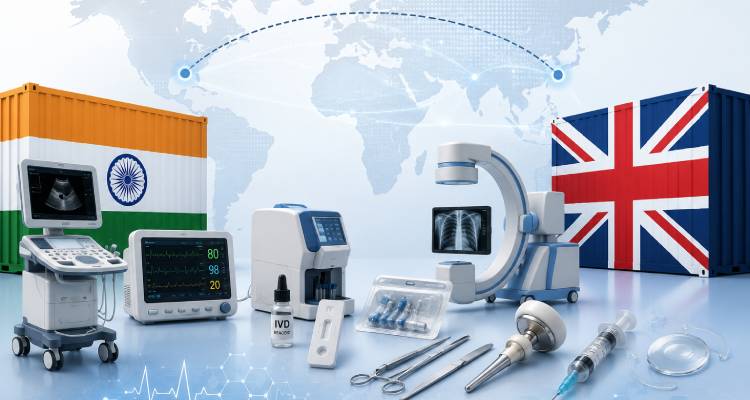
The MedTech sector is expected to be one of the biggest beneficiaries. Indian manufacturers of diagnostic imaging equipment, surgical instruments, orthopedic implants, patient monitoring systems, laboratory devices, hospital consumables, dental equipment and critical care technologies can now access the UK market at more competitive prices. The agreement also opens opportunities to participate in procurement by the NHS, one of the world’s largest publicly funded healthcare systems with an annual budget exceeding GBP 200 billion. For Indian companies, successful entry into the NHS supply chain could significantly enhance global credibility and create pathways into other developed healthcare markets.
Beyond trade, CETA is expected to encourage greater collaboration in medical research, biotechnology, digital health, artificial intelligence, robotics, genomics and clinical innovation. The UK’s expertise in life sciences and advanced healthcare research, combined with India’s large scale manufacturing capabilities and skilled workforce, is likely to drive joint research programmes, technology transfers and innovation partnerships.
The agreement is also expected to attract higher British investments into India’s healthcare and MedTech ecosystem. As global companies adopt the China+1 strategy, India is emerging as a preferred destination for medical device manufacturing, contract manufacturing, Global Capability Centres (GCCs) and research and development facilities. Such investments will support the government’s vision of making India a global hub for healthcare manufacturing under the Make in India initiative.
Perspective on the agreement and its implications for the Indian medical devices industry, Rajiv Nath, Forum Coordinator, Association of Indian Medical Device Industry (AiMeD), said:
“Indian Imports of medical devices from all over world went up last year by 17 % from 77000 Cr Rs to 89,000 Cr Rs (9.3 Billion $) while exports are hovering at 4 Billion $. Currently India’s exports to UK of Medical Devices are stagnant at approximately USD 130 million and imports at 227 million dollars.
“Indian manufacturers face steep challenges in accessing the UK market due to the fair but very costly and time-consuming regulatory approvals required by the UK MHRA or the EU’s CE mark. UK manufacturers, in contrast, obtain CDSCO approvals through a relatively faster and less expensive process that does not even involve factory inspections. Perhaps the time has come to require such inspections, to ensure that only genuine UK-origin products are shipped to India, and not third-country goods using the UK as a transit point.
Our concern is not limited to Chinese origin goods but extends to EU products that may exploit lower duty access. India has already experienced this with Singapore and Netherlands . Notably, Singapore and the Netherlands rank among the top five suppliers of medical devices to India despite limited domestic manufacturing because their efficient ports and tax regimes make them competitive transit hubs. By contrast, stronger production economies like Japan, Korea, Taiwan in Asia and France, Italy, and Spain in EU are surprisingly not as prominent suppliers.”
However, industry experts believe that tariff benefits alone will not guarantee success. Indian exporters must comply with stringent Medicines and Healthcare products Regulatory Agency (MHRA) regulations, Good Manufacturing Practices (GMP), ISO 13485 quality standards and CETA’s Rules of Origin to qualify for preferential market access. Investments in quality, regulatory compliance, sustainability and product innovation will remain essential for long term competitiveness.
The India UK CETA represents more than a trade agreement; it is a strategic partnership that strengthens healthcare cooperation between the two nations. For India’s healthcare and MedTech industries, it offers an unprecedented opportunity to increase exports, attract global investments, accelerate innovation and integrate more deeply into international healthcare supply chains. If effectively leveraged, the agreement could further reinforce India’s position as the “Pharmacy of the World” while establishing it as a trusted global destination for advanced medical technologies and healthcare innovation.