

India hosts WCOG 2026 with Focus on Changing Global GI Disease Burden and Earlier Diagnosis
Opening day of the World Congress of Gastroenterology examines H. pylori, metabolic liver disease, early-onset colorectal cancer, celiac disease and emerging role of AI in gastroenterology New Delhi, September 30, 2026: The World Congress of Gastroenterology

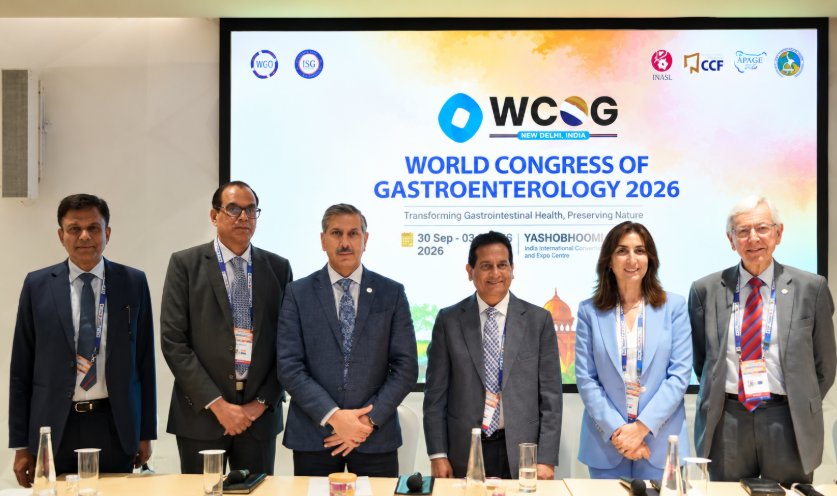
Opening day of the World Congress of Gastroenterology examines H. pylori, metabolic liver disease, early-onset colorectal cancer, celiac disease and emerging role of AI in gastroenterology
New Delhi, September 30, 2026: The World Congress of Gastroenterology (WCOG) 2026 opened in New Delhi today with global and Indian gastroenterology experts examining the changing burden of gastrointestinal and liver diseases, the need for earlier diagnosis and evolving approaches to prevention and treatment. Being held in India for the first time, the four-day Congress has brought together around 3,000 delegates from 61 countries, including leading clinicians and researchers from across the world.
The opening day covered the growing range of infectious, metabolic, inflammatory and malignant gastrointestinal conditions. H. pylori and intestinal worm disease continue to affect large populations. At the same time, metabolic dysfunction-associated steatotic liver disease (MASLD), inflammatory bowel disease (IBD), gastrointestinal cancers and chronic digestive disorders are placing new demands on healthcare systems.
Dr Govind Makharia, Professor, Department of Gastroenterology and Human Nutrition Unit, AIIMS New Delhi, and Chairman, Local Organising Committee, WCOG 2026, said: “The GI disease burden is changing in both its scale and clinical profile. Alongside infections such as H. pylori and parasitic diseases, metabolic and lifestyle-related conditions are becoming increasingly important. This makes timely diagnosis critical, whether for liver disease, colorectal cancer, celiac disease or IBD. WCOG 2026 brings these priorities together and provides an opportunity to look at prevention, diagnosis and treatment across different populations.”
Experts focused on the global rise in early-onset colorectal cancer, including changing risk factors, approaches to risk assessment and the role of screening and emerging non-invasive biomarkers. They discussed the need to identify at-risk populations earlier, particularly where access to diagnostic services remains limited, and the potential of newer approaches to support this.
Dr Pramod Kumar Garg, Professor and Head, Department of Gastroenterology and Human Nutrition Unit, AIIMS New Delhi; President, Indian Society of Gastroenterology; and Co-Chair, Steering Committee, WCOG 2026, said: “The challenges in gastroenterology are increasingly interconnected. H. pylori eradication, better identification of MASLD and improved approaches to colorectal cancer screening all have a role in reducing disease burden. India brings a large and diverse patient population as well as significant clinical and research experience to these
discussions, while the global exchange allows us to learn from approaches being developed in other settings.”
H. pylori was a key area of discussion, spanning its global epidemiology, diagnosis and eradication strategies and the role of effective treatment in reducing gastric cancer risk. The Congress is also examining shifts in gastric cancer epidemiology, approaches to early gastric cancer detection and management of precancerous conditions such as atrophic gastritis and intestinal metaplasia.
The focus on MASLD and liver disease included screening and risk stratification, newer pharmacological approaches and identification of patients at risk of hepatocellular carcinoma. Across the Congress, sessions are also addressing chronic hepatitis B, acute liver failure, acute-on-chronic liver failure and liver transplantation.
Dr Geoffrey Metz, Professor, Epworth Hospital, Richmond, VIC, Australia; Co-Chair, Steering Committee, WCOG 2026 and Past President, World Gastroenterology Organisation, said: “A global congress is valuable because disease patterns, healthcare resources and clinical priorities vary across countries. The focus therefore needs to be on how evidence can be adapted to different healthcare settings. WCOG 2026 brings together that diversity of experience, allowing clinicians and researchers to examine what can be translated into practical approaches to prevention, diagnosis and treatment.”
Celiac disease and IBD were also among the key clinical areas addressed, with discussions spanning newer diagnostic approaches for celiac disease, treatment strategies beyond the traditional gluten-free diet, advanced therapies for IBD, endoscopic surveillance and emerging tools such as bowel ultrasound and multi-omics.
Professor Carolina Olano, Professor and Director, Department of Gastroenterology, Universidad de la República, Uruguay, and President, World Gastroenterology Organisation, said: “Gastrointestinal diseases may present differently across populations, but many of the challenges are shared. Earlier diagnosis, access to evidence-based treatment and stronger prevention strategies remain important priorities. Bringing experts from different regions together helps compare evidence and experiences and identify approaches that can be adapted to local healthcare needs.”
Artificial intelligence and advanced diagnostics are also emerging as important areas of discussion. Research spans deep learning for IBS detection and quantitative interpretation of celiac biopsies. It also includes AI-assisted evaluation of pancreatic cysts and applications in IBD and pancreatic cancer.
Over the next three days, WCOG 2026 will span gastroenterology, hepatology, endoscopy, pancreatic diseases, GI cancers, nutrition, microbiome science and emerging technologies. Key areas include acute and chronic pancreatitis, pancreatic cancer surveillance and early detection, advanced endoscopy, liver transplantation, gut microbiota, precision medicine and the clinical application of AI.
Jointly organised by the Indian Society of Gastroenterology and the World Gastroenterology Organisation, with support from leading Indian gastroenterology and hepatology associations, WCOG 2026 is being held under the theme “Transforming Gastrointestinal Health, Preserving Nature.”