
Health Minister Shri Jagat Prakash Nadda Inaugurates WCOG 2026, PutsGlobalFocus on Gastrointestinal Health
World Congress of Gastroenterology being held in India for the first time, with around 3,000 delegatesfrom 61 countries New Delhi, September 30, 2026: Union Minister for Health & Family Welfare and Chemicals & Fertilizers, Shri Jagat

World Congress of Gastroenterology being held in India for the first time, with around 3,000 delegates
from 61 countries
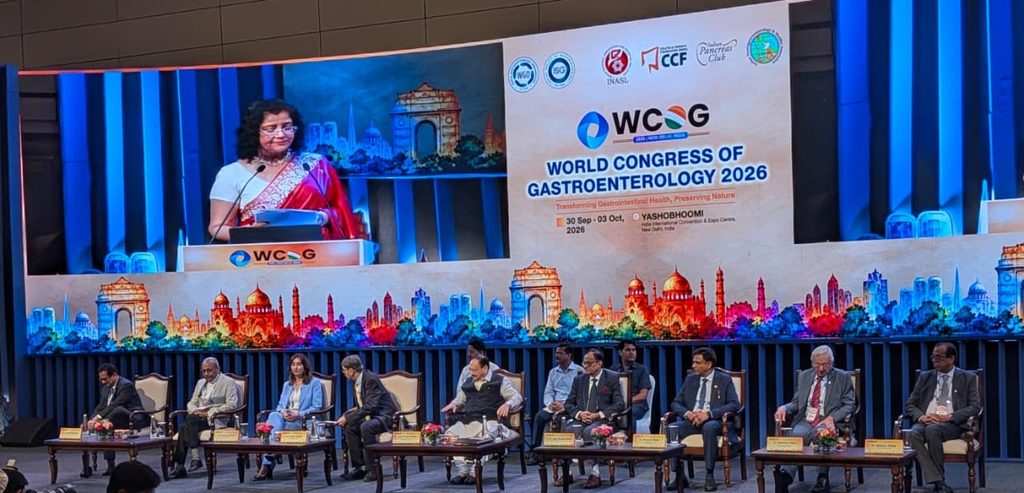
New Delhi, September 30, 2026: Union Minister for Health & Family Welfare and Chemicals & Fertilizers, Shri Jagat Prakash Nadda, today inaugurated the World Congress of Gastroenterology (WCOG) 2026 at Yashobhoomi, New Delhi, marking the first time the global gastroenterology congress is being held in India. Around 3,000 delegates from 61 countries are participating in the four-day Congress, bringing together clinicians and researchers to address the growing and changing burden of gastrointestinal and liver diseases.
The inaugural day witnessed the launch of “10 Commandments for GI Health”, a set of evidence-based recommendations developed by Indian and international gastroenterology experts. The recommendations address prevention, recognition of risk factors and symptoms, and timely medical evaluation. The experts called for these messages to reach people across nations and communities to strengthen awareness of gastrointestinal health and encourage timely care.
Shri Jagat Prakash Nadda, Union Minister for Health & Family Welfare and Chemicals & Fertilizers, said: “Gastrointestinal health is closely linked to nutrition, metabolic health, infection and cancer, making it an important part of the broader public health agenda. India has built significant capabilities across healthcare, medical education and research. Hosting WCOG 2026 provides an opportunity to share this experience with the global gastroenterology community and strengthen international collaboration in research, clinical practice and healthcare delivery.”
Gastrointestinal diseases cut across infectious, metabolic, inflammatory and malignant conditions, affecting populations at different stages of life and across healthcare settings. While infections such as H. pylori and parasitic diseases remain important causes of disease, metabolic liver disease, inflammatory bowel disease and gastrointestinal cancers are increasingly important areas of clinical and public health concern. Earlier recognition, appropriate screening and access to effective treatment remain central to reducing their impact.
Prof. Ajay Kumar Sood, Principal Scientific Advisor to the Government of India, said: “Advances in artificial intelligence, diagnostics, biomedical research and data sciences are creating new possibilities for healthcare. The priority now is to translate these advances into clinically validated solutions that can be applied at population scale. Collaboration between clinicians, researchers and technology communities will be important to achieving this.”
Advances in diagnosis and treatment are reshaping the management of gastrointestinal and liver diseases, from earlier detection of pancreatic and gastrointestinal cancers to newer approaches for pancreatitis, MASLD, IBD, celiac disease and liver failure. H. pylori eradication, precision risk assessment, advanced endoscopy and a growing understanding of the gut microbiome are also changing clinical practice.
Artificial intelligence is opening new possibilities in endoscopy, EUS, pancreatic disease, IBD and gastrointestinal motility, while raising important questions around clinical validation, safety and regulation. Research from India on IBD, colorectal cancer, MASLD, chronic pancreatitis and the human microbiome is adding to the global evidence base, alongside growing understanding of environmental influences such as climate change and ultra-processed foods on gastrointestinal health.
Dr Pramod Kumar Garg, Co-Chair, Steering Committee, WCOG 2026 and President, Indian Society of Gastroenterology, and Dr Govind Makharia, Chairman, Local Organising Committee, WCOG 2026, said: “Gastrointestinal health is a global concern, spanning infections, metabolic and inflammatory
diseases, cancers and chronic digestive conditions. India brings a large and diverse patient population, significant clinical experience and a growing body of research to this global conversation. WCOG 2026 provides an opportunity to share this experience while learning from advances across different healthcare systems, with a common focus on prevention, earlier diagnosis and better outcomes for patients.”
WCOG 2026 will continue until October 3 under the theme “Transforming Gastrointestinal Health. Preserving Nature.” Jointly organised by the Indian Society of Gastroenterology and the World Gastroenterology Organisation, with support from leading Indian gastroenterology and hepatology associations, the Congress is bringing global and Indian perspectives to the prevention, diagnosis and management of gastrointestinal and liver diseases.