
Centre Orders Nationwide Crackdown on Reuse of Single-Use Medical Devices; Patient Safety and Hospital Accountability Under Scrutiny
DGHS directs states and Union Territories to strengthen enforcement across public and private healthcare facilities; reported cases raise concerns over infection control, regulatory compliance and patient billing. The Government of India has directed states and Union

DGHS directs states and Union Territories to strengthen enforcement across public and private healthcare facilities; reported cases raise concerns over infection control, regulatory compliance and patient billing.
The Government of India has directed states and Union Territories to strictly enforce the prohibition on reusing medical devices and disposable surgical items labelled for single use, bringing renewed attention to patient safety, infection prevention, hospital accountability and transparency in healthcare billing.
In a letter dated October 16, 2026, the Directorate General of Health Services (DGHS) flagged reports of certain private and corporate hospitals sterilising and reusing devices intended for one-time use. The practice has reportedly been observed across critical clinical specialities, including cardiology, nephrology, oncology, cardiothoracic and vascular surgery (CTVS), neurosurgery and other specialised services.
The directive calls for strict vigilance, inspections and monitoring of healthcare establishments, with appropriate action against violations under applicable laws and regulations. It also reiterates that medical devices must be used in accordance with the instructions and recommendations of their original equipment manufacturers (OEMs). <escape></escape>
Patient safety at the centre of the directive
The DGHS has warned that reusing devices designed and labelled for a single procedure can expose patients to cross-infection, device malfunction, compromised performance and other procedure-related complications.
The concern extends beyond whether a device has undergone sterilisation. Medical devices designed for one-time use may have intricate structures that make effective cleaning difficult. Reprocessing may also compromise material integrity, functional performance or the reliability of the device, depending on its design and intended use.
Potential consequences include transmission of blood-borne pathogens, including hepatitis B and C and HIV, as well as bacterial infections. In high-risk procedures, device failure or inadequate reprocessing can have serious clinical consequences.
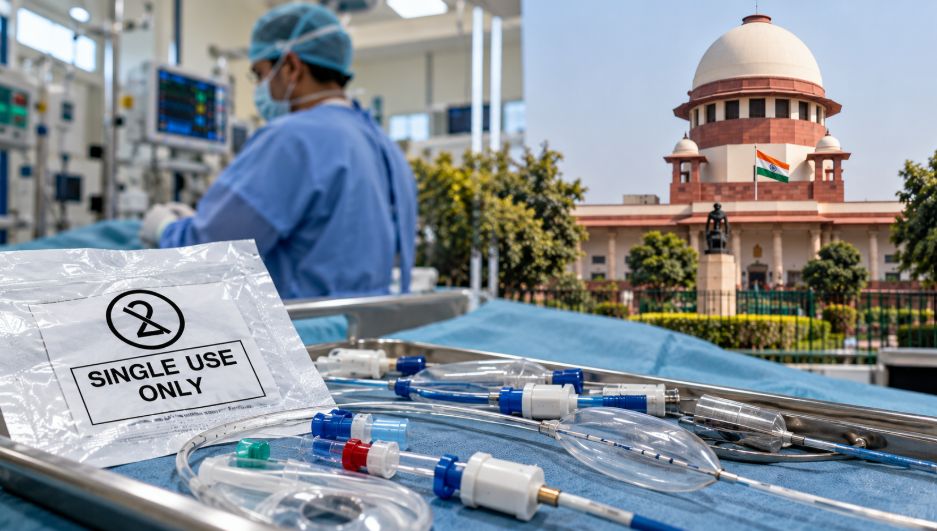
Devices reportedly being reused include cardiac catheters, guidewires, balloon and ablation catheters, introducer sheaths, dialysis equipment such as dialysers and blood tubing, surgical staplers, laparoscopic instruments and orthopaedic drill bits. Disposable syringes and needles have also been identified as areas of concern. Reports have additionally raised concerns about the reimplantation of previously explanted pacemakers.
The critical distinction is that sterilisation does not, by itself, establish that a device labelled for single use is safe or authorised for reuse. The device’s labelling, intended use, manufacturer instructions and applicable regulatory requirements remain central to determining its permitted use.
A longstanding issue with documented historical cases
The latest directive brings renewed scrutiny to a concern that has surfaced in India previously.
In 2017, Maharashtra’s Food and Drug Administration reportedly found that eight private hospitals had reused 1,306 catheters across more than 1,000 patients. The reported case highlighted not only the potential risks associated with reusing medical devices but also concerns about how used devices were handled and charged to patients.
The issue is therefore not confined to infection prevention. It also raises questions about procurement controls, device traceability, clinical governance and the accuracy of hospital billing.
However, these historical findings should not be interpreted as a measure of the current national prevalence of device reuse. No verified, comprehensive nationwide figure establishing how many hospitals or patients are currently affected has been identified in the available reporting.
Regulatory framework: enforcement is the next test
The DGHS directive references existing legal and regulatory provisions, including the Drugs and Cosmetics Act, 1940, the Medical Devices Rules, 2017, the Clinical Establishments Act, 2010, applicable infection prevention and control protocols, and biomedical waste management requirements.
The Medical Devices Rules, 2017, which came into effect on January 1, 2018, provide for appropriate labelling of medical devices intended for single use. The regulatory framework establishes the importance of respecting the manufacturer’s specified intended use and applicable requirements.
The DGHS has asked state and Union Territory health authorities, directors of health services, the Drug Controller General of India (DCGI) and state and UT drug controllers to ensure effective enforcement. Inspections, compliance monitoring and appropriate action against violations are among the measures emphasised.
A further complication is India’s federal healthcare governance structure. In a February 2019 response published by the Press Information Bureau, the Union government stated that the implementation and enforcement of the Clinical Establishments Act fell within the remit of states and Union Territories, and that complaints received by states and action taken to reimburse affected patients were not maintained centrally.
That historical response underscores an important policy challenge: national directives require consistent implementation, monitoring and reporting across jurisdictions to establish their effectiveness.
Patient billing adds a financial accountability dimension
The DGHS has also flagged cases in which the full cost of a reused device was reportedly charged to patients or reimbursed by government authorities.
This raises a separate question of financial transparency. If a device intended for one-time use is reused contrary to its labelling, the patient or public payer may need clarity on what was supplied, how it was used and what was charged.
The wider debate over hospital consumable pricing adds context. An India Today report published on October 23, 2026, cited a Maharashtra hospital-consumables survey in which an intravenous infusion set reportedly purchased for ₹11.05 carried a printed price of ₹325—a reported markup of approximately 2,841%. The report also cited an earlier National Pharmaceutical Pricing Authority analysis of four major private hospitals that found margins of up to 1,737% on drugs, consumables, devices and diagnostics.
These pricing figures are separate from the evidence concerning device reuse; they do not establish that reuse caused the markups. They nevertheless illustrate why procurement practices, consumable pricing and patient billing remain important elements of healthcare accountability.
The immediate regulatory priority is to ensure that devices are used safely and billed transparently, with clear records and appropriate oversight.
Medical device industry calls for stronger accountability
The Association of Indian Medical Device Industry (AiMeD) has welcomed the directive, maintaining that products designed and validated for one-time use should not be cleaned, resterilised and reused contrary to their intended use.
Rajiv Nath, forum coordinator at AiMeD, has called for regular inspections, traceable records of device use and disposal, staff training in infection prevention and biomedical waste handling, and clarity over responsibility when devices are reused against manufacturers’ instructions.
The industry body has also argued that manufacturers should not automatically bear responsibility for failures arising from unauthorised reuse contrary to product labelling. Clear accountability would need to be established through the applicable legal and regulatory framework.
It has further emphasised the importance of ensuring that cost pressures do not encourage unsafe practices, including through access to safe and affordable single-use alternatives.
What healthcare institutions must prioritise
The directive places renewed emphasis on operational compliance within hospitals. Healthcare institutions need to ensure that their procurement, clinical, infection-control, billing and biomedical waste management systems operate in alignment.
Key priorities include:
- Device-use compliance: Ensure that products labelled for single use are not reused contrary to their instructions and applicable requirements.
- Traceability and documentation: Maintain auditable records of device procurement, use, disposal and relevant patient billing.
- Infection prevention: Strengthen protocols, staff training and internal monitoring across clinical departments.
- Regulatory oversight: Facilitate inspections, address non-compliance and establish clear accountability for violations.
- Billing transparency: Ensure that charges to patients and reimbursements by public authorities accurately reflect the devices and services provided.
- Patient awareness: Support informed discussions about medical devices, their intended use and relevant treatment charges.
The road ahead: from directive to measurable compliance
The DGHS order is a significant regulatory reminder, but its impact will depend on implementation. The immediate question is whether states and Union Territories can translate the directive into consistent inspections, reliable documentation, corrective action and transparent reporting.
Three areas merit particular attention: the number and findings of inspections conducted, the nature of violations detected and the corrective or enforcement action taken. Publicly available, consolidated data on these indicators would help assess the scale of the problem and the effectiveness of the response.
Equally important is the development of a stronger accountability framework that protects patients without creating ambiguity over the respective responsibilities of healthcare establishments, manufacturers and regulators.
The central principle is straightforward: patient safety cannot be compromised by operational convenience or cost considerations. A medical device’s intended use, the applicable regulatory framework and the patient’s right to safe and transparent care must remain the foundation of clinical practice.
For India’s healthcare system, the real measure of this directive will not be the prohibition alone, but whether it produces verifiable improvements in patient safety, regulatory compliance and institutional accountability.
By MedGate Today Bureau