
Cancer Drug Pricing: Supreme Court Flags 10-Fold Markup, Questions High Medicine Prices and Hospital Practices
New Delhi, September 30, 2026: The Supreme Court of India has raised serious concerns over the wide disparity between the price at which certain cancer medicines are supplied to retailers and the Maximum Retail Price

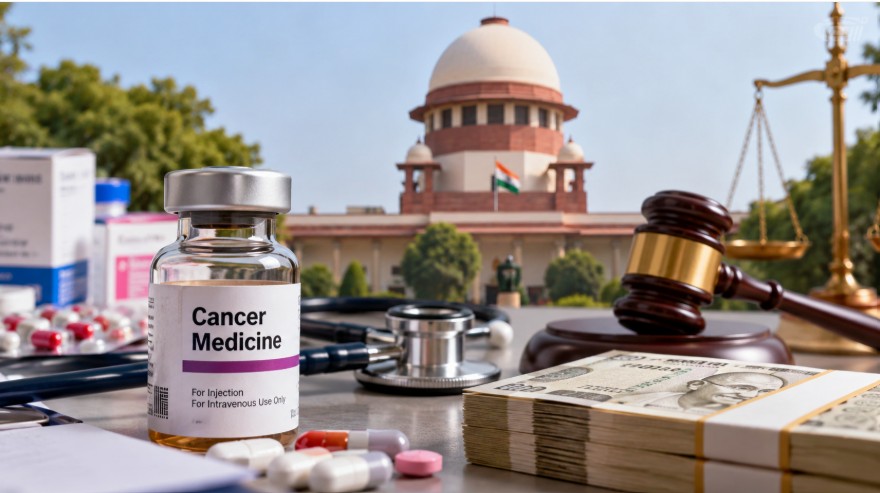
New Delhi, September 30, 2026: The Supreme Court of India has raised serious concerns over the wide disparity between the price at which certain cancer medicines are supplied to retailers and the Maximum Retail Price (MRP) printed on the medicines, bringing renewed attention to cancer drug pricing, hospital markups and the affordability of cancer treatment in India.
During proceedings on regulation of medicine prices, the Court questioned how a cancer medicine reportedly supplied to retailers at around ₹2,700 could carry an MRP of ₹27,000 a ten-fold difference. The Bench of Justices Vikram Nath and Sandeep Mehta also questioned the rationale behind such a substantial gap and examined whether stronger controls were required to protect patients from excessive medicine costs.
The Court has asked the government to examine a proposal for a uniform 16% margin over the Price to Retailer (PTR) for medicines. The matter is scheduled for further hearing on October 12, 2026. The proceedings are part of a broader examination of medicine pricing regulation, including issues relating to the Drugs (Prices Control) Order, 2013 (DPCO), generic medicines and medical devices.
Cancer Drug Pricing Under the Regulatory Lens
The Supreme Court’s observations come against an existing regulatory framework administered by the National Pharmaceutical Pricing Authority (NPPA). Under the DPCO, 2013, NPPA fixes ceiling prices for medicines included in Schedule I, based on the National List of Essential Medicines (NLEM).
According to the Ministry of Chemicals and Fertilizers, as of March 9, 2026, ceiling prices were effective for 131 anti-cancer drugs. The government stated that the revised ceiling prices resulted in an approximately 21% reduction compared with prices fixed under NLEM 2015, with estimated annual savings of approximately ₹294 crore for patients.
The government has also stated that NPPA has fixed retail prices for 58 anti-cancer formulations under the applicable provisions for new drugs, covering 31 anti-cancer drugs, 26 anti-neoplastic drugs and one immunosuppressive drug. For non-scheduled anti-cancer formulations, manufacturers are required not to increase MRP by more than 10% over the preceding 12-month period.
Earlier government data also recorded a 30% trade-margin cap on 42 non-scheduled anti-cancer medicines, which resulted in MRP reductions across 526 brands by an average of around 50%, with estimated annual savings of approximately ₹984 crore to patients.
Why the Court’s Intervention Matters
The issue goes beyond the printed price of an individual medicine. Cancer treatment frequently involves repeated cycles of chemotherapy, targeted therapy, immunotherapy, supportive medicines, diagnostics and hospital-based care. Consequently, medicine pricing can have a significant impact on the overall financial burden faced by patients and families.
The Supreme Court has also examined allegations concerning private hospitals requiring patients to purchase medicines, devices, implants or consumables through hospital-operated or designated pharmacies. In its broader proceedings, the Court has considered whether such practices can contribute to inflated treatment costs and whether patients should have greater protection against excessive pricing.
The current proceedings therefore place medicine affordability, pricing transparency and patient protection at the centre of a wider healthcare policy discussion.
The Road Ahead for Cancer Care in India
India already has multiple mechanisms for controlling medicine prices, but the Supreme Court’s latest observations highlight questions around the relationship between PTR, MRP, trade margins and the final price paid by patients.
Any future regulatory intervention will need to balance affordability and transparency with the economics of pharmaceutical manufacturing, distribution, retailing and hospital-based care. The outcome of the proceedings could therefore have implications extending beyond oncology to the broader pharmaceutical pricing ecosystem.
For patients battling cancer, however, the central issue remains straightforward: access to essential medicines should not become an additional barrier to accessing essential healthcare.
The Supreme Court’s scrutiny has once again brought cancer drug pricing into national focus, placing affordability, transparency and patient interest firmly at the heart of India’s healthcare policy conversation.