
GIMS Greater Noida Plans Major Healthcare Expansion with Four New Super-Speciality Departments
The institute has approved a 10-year development roadmap until 2035, focusing on specialised treatment facilities, medical education, research and infrastructure development. The Government Institute of Medical Sciences (GIMS), Greater Noida, is preparing for a major institutional

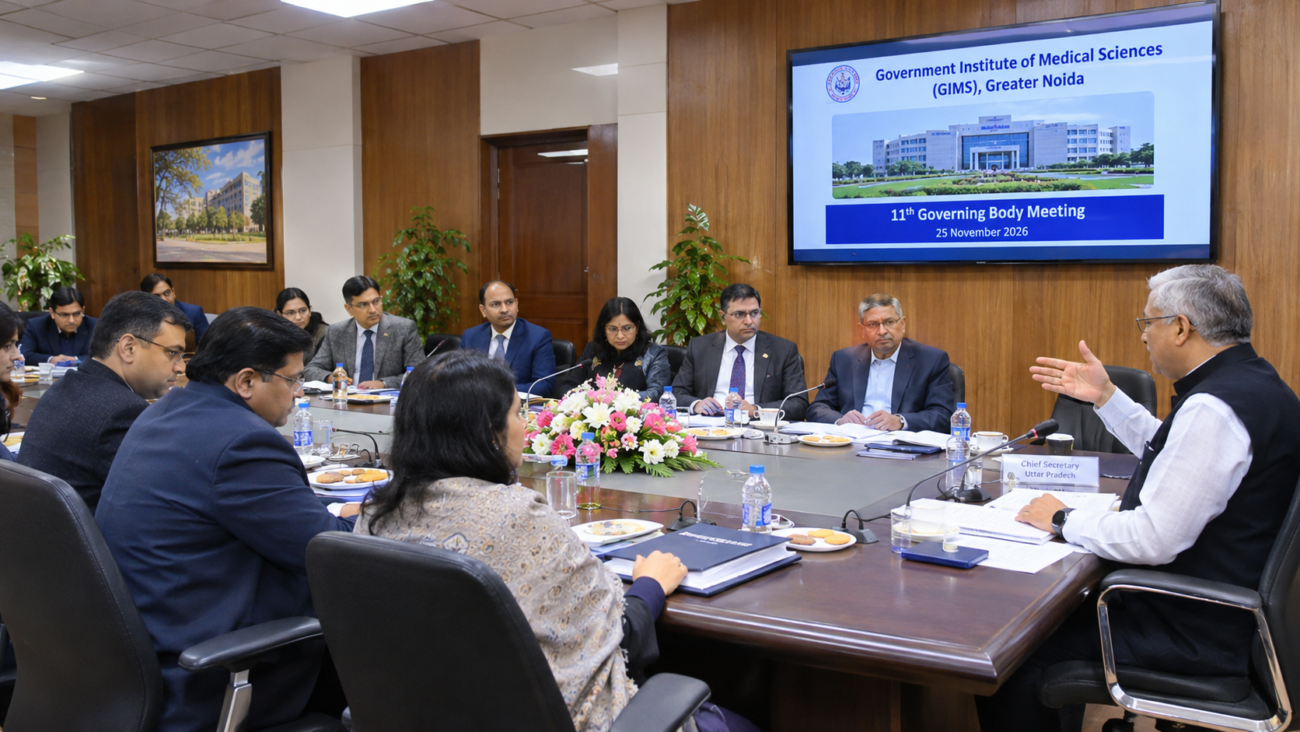
The institute has approved a 10-year development roadmap until 2035, focusing on specialised treatment facilities, medical education, research and infrastructure development.
The Government Institute of Medical Sciences (GIMS), Greater Noida, is preparing for a major institutional expansion following the approval of four additional super-speciality departments and a long-term development strategy extending until 2035.
The decisions are expected to strengthen the institute’s specialised healthcare capabilities while creating new opportunities in medical education, clinical research and advanced patient care.
The approvals were finalised during the 11th Governing Body meeting held on November 25, 2026. The meeting was chaired by Uttar Pradesh Chief Secretary S.P. Goyal, who also serves as President of the GIMS Society.
GIMS to Expand Super-Speciality Healthcare Services
Under the latest decision, GIMS will add four super-speciality departments to the eight departments previously approved at the institute. This expansion is expected to broaden the range of specialised medical services available to patients in Greater Noida and surrounding districts.
The governing body also cleared proposals for establishing a dedicated Cornea Transplant Centre and a Comprehensive Haemophilia Treatment Centre for adult patients. These facilities are intended to strengthen access to specialised eye care and haemophilia management.
Three-Phase Development Strategy Until 2035
The newly approved GIMS Greater Noida expansion plan outlines three development phases designed to guide the institute’s growth over the next decade.
The first phase, covering the period until 2028, will prioritise essential infrastructure development and improvements in healthcare delivery. The subsequent five-year strategy, extending to 2031, will concentrate on expanding clinical departments, academic programmes and research activities.
The final phase will focus on developing advanced healthcare infrastructure, encouraging innovation and improving institutional rankings and accreditation standards.
Medical Education and Research Expansion
Academic development also featured prominently during the meeting. Proposals included increasing MBBS admission capacity to 250 seats and expanding B.Sc. Nursing intake to 100 seats.
The introduction of a Nurse Practitioner programme was also discussed to strengthen specialised nursing education and address healthcare workforce requirements.
Additionally, proposed academic departments covering Hospital Administration, Biostatistics and Health Informatics, Digital Health and Telemedicine, and IRF were considered.
Focus on Quality Accreditation and Innovation
The Governing Body appreciated GIMS for achieving National Accreditation Board for Hospitals and Healthcare Providers (NABH) and National Accreditation Board for Testing and Calibration Laboratories (NABL) accreditations.
The Chief Secretary also encouraged other government medical colleges and healthcare institutions in Uttar Pradesh to pursue similar quality certifications.
Other discussions covered hospital basement infrastructure and the proposed medical college project. The institute also approved the adoption of the National Innovation and Startup Policy (NISP), 2019, to promote entrepreneurship, research and innovation.
With these initiatives, GIMS Greater Noida aims to strengthen its position as a developing centre for specialised healthcare, medical education and research in Uttar Pradesh.
By MedGate Bureau