
India Health 2025 Hosts Power-Packed Panel on “Smart Hospitals for the Decade” — Technology, Design & Data Converge to Shape the Future of Healthcare
One of the most engaging highlights at India Health 2025 was the thought-provoking session on “Building the Smart Hospital for the Decade”, which brought together a multidisciplinary panel of experts — from healthcare architects and

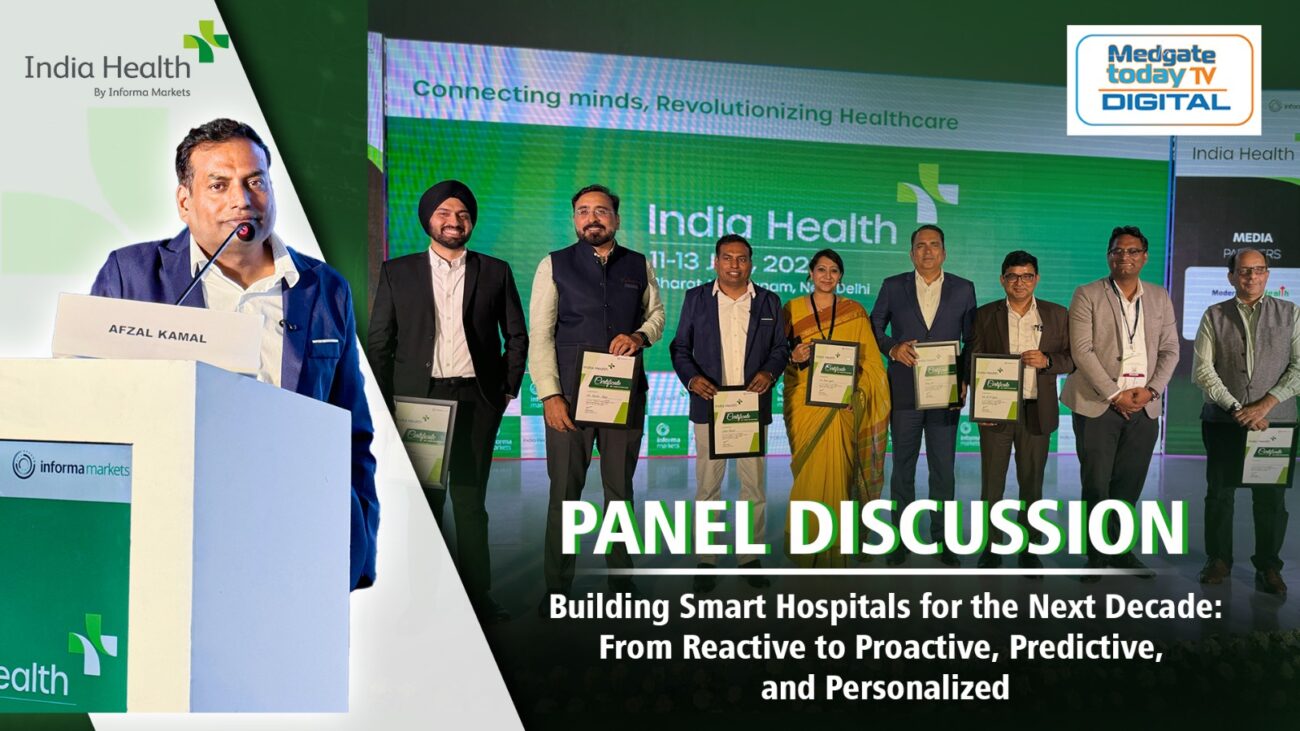
One of the most engaging highlights at India Health 2025 was the thought-provoking session on “Building the Smart Hospital for the Decade”, which brought together a multidisciplinary panel of experts — from healthcare architects and clinicians to hospital promoters, technologists, and cyber-security professionals. The session delved deep into the practical vision, infrastructural design, patient experience, data protection, and return on investment in building next-generation hospitals.
The session kicked off with an immersive experience shared by the moderator, recalling a visit to Taipei Medical Center in Taiwan in 2019 – an institution that fully embraced digital transformation. From smart parking using national health cards to robotic consultation assistants and self-service kiosks for vitals, the hospital demonstrated what it truly means to be a smart facility.
“Am I looking smart? Just like that, how can a hospital look smart?” the moderator quipped, engaging the audience before sharing how the hospital’s AI-driven ecosystem reduced human intervention, empowered patients, and optimized clinical workflows – all six years ago.
Shruti’s Caution: The Double-Edged Sword of AI
Highlights from Other Key Panelists
Dr. D.K. Gupta, a healthcare entrepreneur and hospital builder, addressed the ROI dilemma that comes with the ₹1.25 crore per bed investment in smart infrastructure.
“Smart hospitals begin at the concept stage — not post-construction. If your design isn’t future-ready, retrofitting becomes an expensive and inefficient journey. Process engineering, patient safety, and clinical excellence are all dependent on how smartly your hospital is built and run,” he emphasized.
Dr. Suchin Bajaj, known for his successful expansion in Tier 2 and Tier 3 cities, argued that geographical location is no longer a barrier to innovation.
“Yes, smart hospitals are absolutely possible outside metros. If done right, automation and AI can reduce cost and improve access. But we must approach AI with seriousness — it’s not just another trend, it’s a revolution,” he asserted.
Adding a crucial angle to the conversation, Mr. Sameer Mathur spoke about cybersecurity, especially in light of the Digital Personal Data Protection Act (DPDPA).
“Hospitals, even big ones, are barely discussing DPDPA. In Tier 2 and 3 cities, it’s practically off the radar. But the threat is real — medical data is private, and its misuse can have devastating consequences. Ignoring this aspect while going digital is dangerous,” he warned.
Mr. Chhitej Kumar focused on the progress India is making in robotic and semi-automated pharmacy systems. Citing the Tan Tock Seng Hospital in Singapore, he explained how robotic installations there can process 1,400 prescriptions per day, cutting average processing time to 14 seconds per pack.
“In India, we’ve already implemented pneumatic tube systems and charging watch stations for inpatient (IP) pharmacies — and more robotic advancements are in the pipeline,” he added.
Ar. Shruti, one of the key panelists, offered a powerful and timely word of caution about the blind optimism surrounding AI.
“We are often quick to compare AI to how horse carts were replaced by cars or how washing machines replaced manual labor. But this rise of AI is far more powerful. It is closer to the scale of how the human species evolved — and that brings both opportunity and immense responsibility,” she warned.
She stressed the need for governance frameworks, ethical AI adoption, and long-term planning to avoid disruptions that could harm rather than heal. Her perspective added depth to the discussion, reminding everyone that technology must serve humans – not replace their compassion.
Architect Ravideep Singh, a seasoned hospital planner, emphasized that smart hospitals must be planned, not patched.
“You cannot inject smart features into a traditional layout. The cost of redesigning later — in terms of both infrastructure and inefficiency — is huge. The concept of smartness must begin from the architectural blueprint. Infrastructure, power, IT backbones, modular zones — all of this must be envisioned from day zero,” he explained, highlighting why India’s healthcare infrastructure must shift toward intelligent planning.
Conclusion: Smart Hospitals Require Smart Planning
The panel unanimously agreed that smart hospitals must be designed, not improvised, with a focus on scalability, interoperability, clinical outcomes, and patient-centricity. Automation, AI, IoT, and digital workflows are not just value additions — they are essentials.
The session wrapped up with a vote of thanks by the moderator, who appreciated each panelist for joining the discussion on personal invitation and contributing to shaping India’s smart healthcare future.