
THE CONFLICTED WORLD OF HEALTHCARE ACCREDITATION
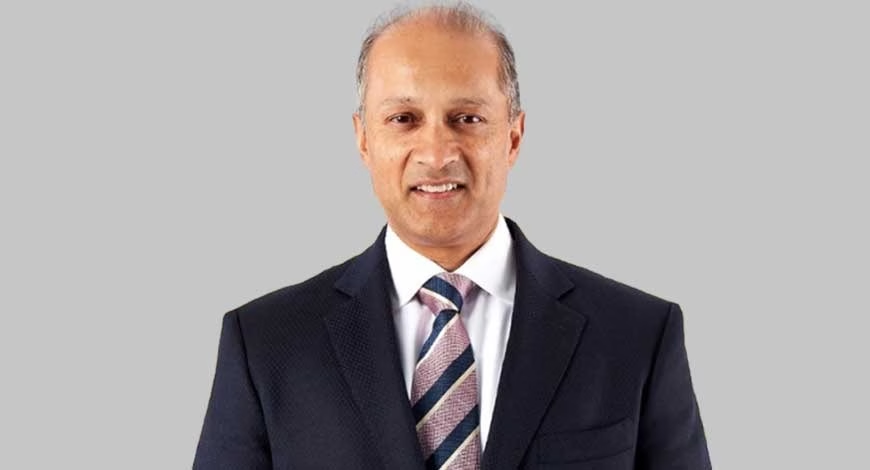
Anil Jauhri Ex-CEO, National Accreditation Board for Certification Bodies Quality Council of India My first encounter with what is called ‘healthcare accreditation’ was when I, as head of management systems certification in BIS in late 2005, heard of


Anil Jauhri
Ex-CEO, National Accreditation Board for Certification Bodies
Quality Council of India
My first encounter with what is called ‘healthcare accreditation’ was when I, as head of management systems certification in BIS in late 2005, heard of setting up of the National Accreditation Board for Hospitals and Healthcare Providers (NABH) within the Quality Council of India (QCI) and the launch of the first hospital accreditation standard.
It aroused my curiosity since we were used to the concept of accreditation as defined by ISO – that of attestation of competence of conformity assessment bodies like testing labs, inspection bodies and certification bodies.
Soon thereafter in Jan, 2006, I myself landed in QCI as adviser and immediately requested the then Secretary General, now Dr G.J. Gyani, and founder of NABH, to let me attend one program of NABH to understand what it was all about. He promptly agreed and I attended a one day session in Pune where I heard one of the best lectures on quality by Dr. Y. P. Bhatia, a veteran now in the field of healthcare quality.
That is when I realized that healthcare accreditation was about processes – as was accreditation in education – not as focussed on ‘competence’ as accreditation defined by ISO was – and was essentially process certification.
In years thereafter, I watched the impressive growth of NABH including its endorsement by the International Society for Quality in Healthcare (ISQua) to bring it global equivalence, while performing my own role in another Board of QCI, the National Accreditation Board for Certification Bodies (NABCB), and even attended NABH Board meetings as CEO, NABCB.
However, I remained on the periphery of healthcare quality except occasionally arguing that India needs to notify and implement minimum standards as envisaged under the Clinical Establishment Act to upgrade mass healthcare quality and accreditation, while showcasing world class excellence, would not serve India’s needs alone given the numbers involved and penetration of accreditation even after 20 years.
I have had to take a closer look at healthcare accreditation and indeed education accreditation when Ministry of Ayush invited me to chair a Working Group of experts to identify Ayush products and services which meet global standards in Jan, 2025 – which culminated in the launch of Ayush Quality Mark by the Hon’ble Prime Minister in Dec, 2025 and the detailed systems have been placed in public domain at link https://ayushexcil.in/ayushmark
What I discovered, to my surprise, is the inherent conflict of interest in healthcare accreditation where the accreditation body can engage in both consulting and accreditation within the same legal entity.
The operative clause in the Guidelines and Standards for External Evaluation Organisations
5th Edition Version 1.1, March 2022 issued by the International Society for Quality in Health Care External Evaluation Association (ISQua EEA) is:
“Criterion 1.7
There is a defined separation between the external evaluation activities and any consultancy services offered and this is communicated to all staff, clients and other stakeholders”
This is contrary to much maligned ISO standards for accreditation and certification which clearly prohibit consulting by accreditation and certification bodies.
ISO 17011 for accreditation bodies states:
“4.4.11 The accreditation body and any part of the same legal entity shall not offer or provide any service that affects its impartiality, such as:
- a) conformity assessment activities covered by accreditation which include but are not limited to testing, calibration, inspection, certification of management systems, persons, products, processes and services, provision of proficiency testing, production of reference materials, validation and verification;
- b) consultancy.”
ISO 17021-1 which is the basis of ISO 9001 and other management systems certification globally states:
“5.2.5 The certification body and any part of the same legal entity and any entity under the organizational control of the certification body [see 9.5.1.2, bullet b)] shall not offer or provide management system consultancy. This also applies to that part of government identified as the certification body.”
ISO 17065 which applies to product and process certifications states:
(4.2.6 The certification body or any part of the same legal entity & entities under its organizational control (see 7.6.4) shall not:
- be the designer, manufacturer, installer, distributer or maintainer of the certified product;
- be the designer, implementer, operator or maintainer of the certified process;
- be the designer, implementer, provider or maintainer of the certified service;
- offer or provide consultancy (see 3.2) to its clients;
- offer or provide management system consultancy or internal auditing to its clients where the certification scheme requires the evaluation of the client’s management system.
Its a globally recognized fundamental principle of auditing that one does not audit his own work which is clearly violated in healthcare accreditation. To say that the same people in the healthcare accreditation body will not engage in both consulting and assessment of the same organization is fallacious and a way to circumvent the fundamental principle.
The Working Group in Ayush therefore decided to prescribe additional requirements and prohibit consulting by healthcare accreditation bodies. It might mean some of the well-known healthcare accreditation bodies are rendered ineligible under the Ayush Quality Mark Programme unless they change their practice but integrity, independence and impartiality should prevail.
What else promotes conflict of interest?
When an organization is prohibited from engaging in consultancy, it should follow that its personnel are also prohibited from consulting. This should apply to both internal and external resources. However, even the ISO standards are compromised in this regard allowing consultants to be empanelled as auditors which creates a conflicted market. Same applies to ISQUA EEA which of course having allowed consulting by healthcare accreditation bodies themselves cannot possibly bar consulting by its personnel!
What else can possibly be conflict of interest?
How about health care accreditation body being owned by a chain of hospitals or a healthcare consulting body? Surely not acceptable.
Do remember that impartiality is also as much about perception as about actual conflict of interest alone.
How about healthcare accreditation body approving or empanelling consultants? Does that bring conflict with its impartiality? Yes, it does.
How can one be sure that when faced with consulting by its own approved or empanelled consultant at a client’s place, the healthcare accreditation body or its assessors would raise any substantive issues lest they prove that consulting was inadequate. Which in turn would reflect on the empanelment or approval process and competence of healthcare accreditation body itself.
In fact, the healthcare accreditation bodies have to stay as far as is possible from consulting or consultants.
Since healthcare accreditation body develops and owns the program of accreditation in any domain be it hospitals or blood banks or dental clinics or homecare, it is nonetheless best placed to train resources in the market. Therefore, the best it can do is to organize public trainings, not inhouse trainings which may be a conflict too, on its standards and train resources which then can go into the market and play whatever role they feel like – as quality professionals within healthcare establishments or consulting or even auditing.
In the Indian context, we have a huge skill ecosystem with sector skill councils in various domains and healthcare is there too. It would be desirable that the Healthcare Sector Skill Council certifies trainings or professionals independently to meet the needs of the healthcare sector while healthcare accreditation bodies focus on just high integrity accreditation free from any actual or perceived conflict of interest.
But the fundamental principles of independence and impartiality should prevail especially in such a sensitive area as healthcare. The Ayush Quality Mark Programme has prescribed clear requirements for the same to set a benchmark which hopefully would be increasingly followed especially by the national and apex bodies in accreditation and certification.
(Reproduced with thanks from author’s column in mediamap.co.in)