

Different Tobacco Policies, Shared Public-Health Challenge: The India-Japan Opportunity
As New Delhi and Tokyo deepen a strategic partnership spanning semiconductors, clean energy and pharmaceuticals, tobacco control remains one area where the two countries have deliberately taken different paths. When Prime Minister Sanae Takaichi and Prime

As New Delhi and Tokyo deepen a strategic partnership spanning semiconductors, clean energy and pharmaceuticals, tobacco control remains one area where the two countries have deliberately taken different paths.
When Prime Minister Sanae Takaichi and Prime Minister Narendra Modi met in New Delhi in July for the 16th India-Japan Annual Summit, their joint statement covered critical minerals, clean energy, pharmaceuticals and biotechnology. Health featured prominently; tobacco control did not. Yet the subject offers a useful window into how two major Asian economies are navigating a fast-evolving nicotine landscape.
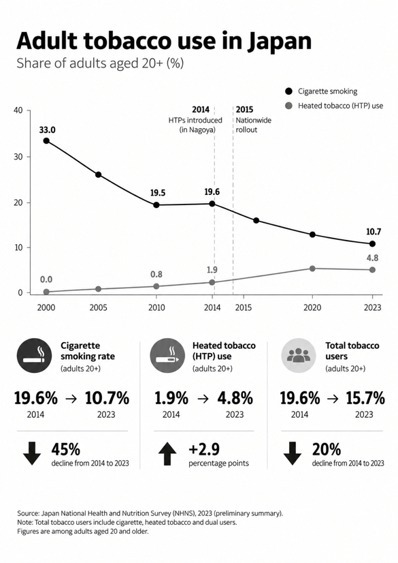
Japan has run one of the world’s most closely watched real-world experiments in tobacco control. Since 2014, heated tobacco devices which heat rather than burn tobacco have grown to account for roughly a quarter of the country’s tobacco market by volume.
Research has tracked what followed. A Tobacco Control study using retail sales data across 11 of Japan’s 12 regions found that cigarette sales, already declining since 2011, fell more rapidly after heated tobacco products went nationwide the rate of decline accelerated roughly fivefold, researchers estimated. A separate analysis in the International Journal of Environmental Research and Public Health reached a similar conclusion using different data, while cautioning that sales figures alone cannot confirm whether individual smokers switched products or whether other factors drove the decline. Japan’s Ministry of Health, Labour and Welfare has separately studied indoor air quality linked to heated tobacco aerosol, reporting substantially lower exposure levels than cigarette smoke in designated smoking rooms — while stressing that lower exposure does not mean the products are safe.
Dr. Hiroya Kumamaru, Cardiovascular Surgeon and Vice Director at AOI International Hospital, Kawasaki, has tracked the shift since it began. “This recent phenomenon of tobacco harm reduction in Japan proves that technology and innovation can accelerate the decline of smoking and reduce the enormous health burden caused by tobacco. It also shows that culturally appropriate solutions, adapted to national contexts, can work at scale. Japan should defend this achievement on the world stage. With smoking still a leading cause of disease and death worldwide, our experience provides a valuable model for other countries. Japan has already shown extraordinary results by allowing millions of smokers to choose a less harmful option
India has taken a different route. Since 2019, the Prohibition of Electronic Cigarettes Act has banned the production, import, sale and advertising of e-cigarettes and heated tobacco products; the health ministry reaffirmed in February this year that it is not considering relaxing the ban. That position reflects India’s broader tobacco-control priorities. With tobacco use linked to more than a million deaths annually, and bidis and smokeless tobacco still major segments of the market, policymakers have concentrated on taxation, cessation, enforcement and preventing youth uptake of newer nicotine products.
The underlying evidence, meanwhile, continues to develop. Independent reviews have found that heated tobacco aerosols contain substantially lower levels of several harmful chemicals than cigarette smoke, while also cautioning that reduced exposure has not yet been conclusively linked to reduced disease risk at the population level. This is where the India-Japan contrast becomes genuinely useful not as a contest between regulatory models, but as two different datasets that could sharpen the evidence base for both countries.
Dr Pawan Gupta, Director – Centre For Chest & Respiratory Diseases, BLK-Max Super Speciality Hospital, Delhi, frames the opportunity this way: “Japan offers experience in monitoring a rapidly changing nicotine market, collecting detailed market and health data and studying differentiated regulatory approaches. India brings extensive experience in taxation, cessation, enforcement and addressing a diverse tobacco market that includes large informal and smokeless segments. Greater exchange between researchers, public-health institutions and policymakers could help both countries identify what is transferable and what is context-specific. Joint studies, shared surveillance methodologies and transparent evaluation of emerging evidence could be particularly valuable, allowing findings from one market to be tested against experience in another.”
That kind of exchange works best when it isn’t left to governments and researchers alone. Manufacturers developing newer products hold technical and market data that could usefully inform the evidence base but that data carries weight only when it is disclosed transparently and tested by independent researchers and public-health institutions, not treated as a substitute for their scrutiny.
India and Japan do not need to converge on the same nicotine policy to learn from each other. Their different approaches offer an opening for real scientific and public-health dialogue. In a debate where the evidence is still taking shape, more knowledge exchange, stronger independent research and sustained health surveillance may do more good, in the long run, than the search for one model that fits every country.