
Building Future-Ready ICUs: Silent, Connected, and Care Centered
Shalin Patel, CE0 | Dräger Asia Pacific For decades, intensive care units have been designed around one central priority: rapid clinical response. Monitors beep, ventilators alarm, infusion pumps notify, and healthcare professionals react in real time.


Shalin Patel, CE0 | Dräger Asia Pacific
For decades, intensive care units have been designed around one central priority: rapid clinical response. Monitors beep, ventilators alarm, infusion pumps notify, and healthcare professionals react in real time. While these alarms play a critical role in patient safety, they have also created an unintended consequence an ICU environment characterized by constant noise, cognitive overload, and alarm fatigue.
As healthcare systems worldwide navigate the next phase of digital transformation, the future ICU is being reimagined as a safer, quieter, and more connected care environment.
Studies have shown that excessive alarm noise can contribute to patient stress, sleep disruption, increased delirium risk, prolonged recovery, and caregiver fatigue. Modern ICUs are among the most technologically advanced areas within hospitals, but they are also among the noisiest. Hundreds of alarms may occur per patient each day, with a significant proportion requiring no clinical intervention. The result is a dual challenge: patients experience heightened anxiety and interrupted recovery, while clinicians face alarm fatigue and increased cognitive burden.
As healthcare organizations place greater emphasis on patient experience, staff well-being, and operational efficiency, reducing unnecessary noise is no longer simply an environmental consideration it is becoming a clinical and strategic imperative.
This reflects a broader shift from device centric care to patient centric healing environments where technology works seamlessly in the background, enabling caregivers to focus on what matters most: the patient.
From Alarms to Actionable Intelligence
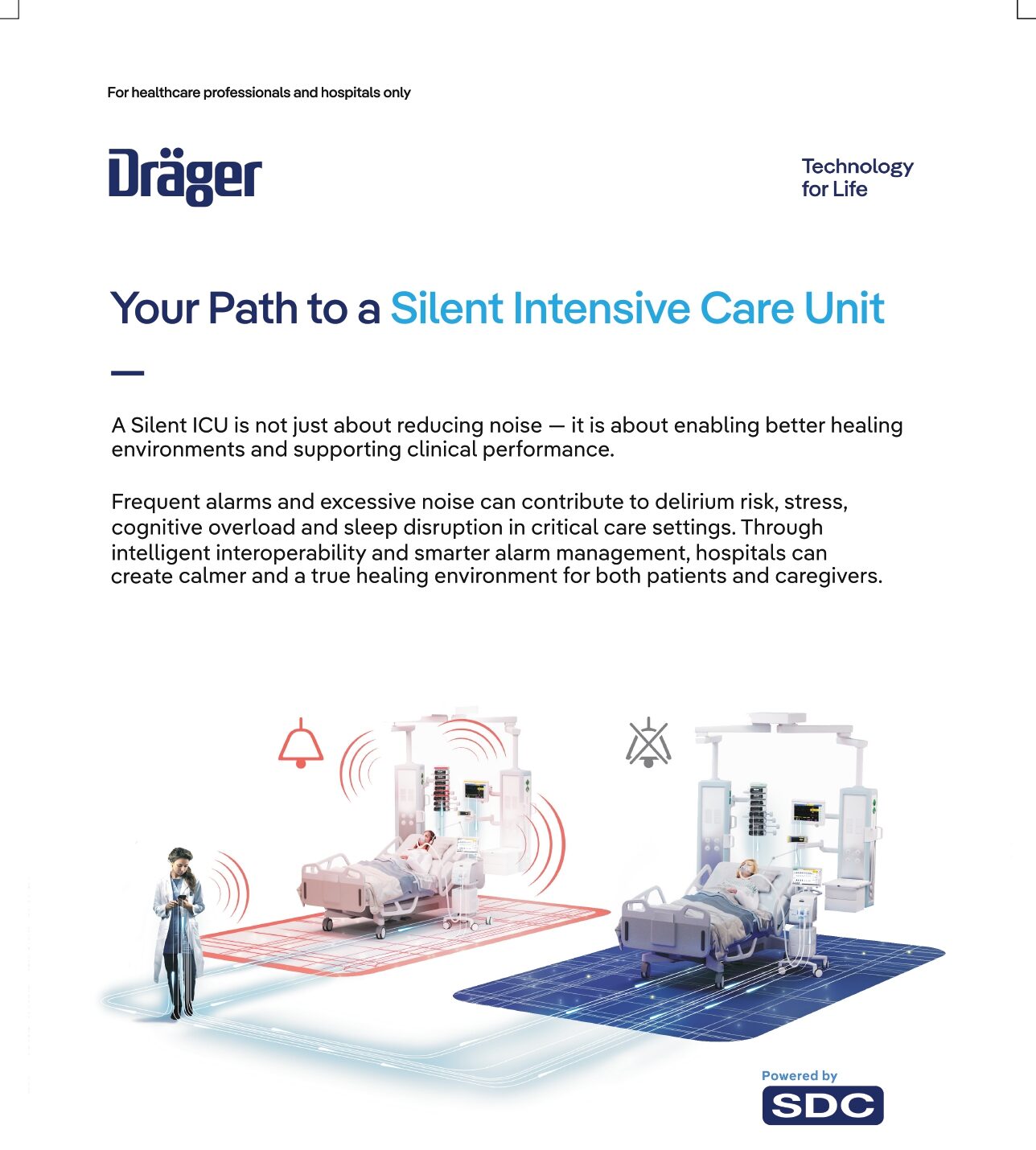
Advances in interoperability standards and connected medical technologies now enable devices from different manufacturers to securely exchange information and communicate in real time. Rather than sounding alarms at the bedside, alerts can be intelligently routed to the appropriate caregiver through centralized alarm management systems. The result is a calmer, more organized care environment where clinicians receive prioritized, contextual notifications and patients benefit from reduced noise and fewer disruptions. In this model, alarms evolve from ambient noise into actionable intelligence.
At Dräger, we continue to invest in partnerships that accelerate meaningful innovation. Our collaboration with Ascom and B. Braun on the Silent ICU solution is a powerful example of this commitment. Together, we are advancing interoperable critical care ecosystems that seamlessly connect monitoring, ventilation, infusion, and alarm management systems to improve workflow efficiency, patient safety, and clinical decision making.
The Silent ICU is more than a technology solution it is a demonstration of how collaborative innovation can redefine critical care by creating quieter, smarter, and more human centered intensive care environments. More importantly, it reinforces Dräger’s leadership in driving open, vendor neutral innovation that enables hospitals to embrace the digital ICU of the future with confidence.
Turning Vision into Reality
As healthcare increasingly moves toward connected and data driven and scalable care delivery, we believe the industry is approaching a pivotal moment in the evolution of critical care.
Today’s hospitals require solutions that are not only intelligent and connected but also flexible enough to adapt to changing clinical demands. Critical care environments must evolve alongside patient volumes, treatment protocols, staffing models, and healthcare infrastructure requirements.
With decades of critical care expertise, Dräger supports healthcare providers across the entire continuum of ICU development. From ICU planning and design consulting to modular critical care infrastructure, medical supply units and pendants, advanced ventilation and therapy solutions, digital connectivity, and lifecycle services, we help hospitals create future ready care environments. Equally important, it allows them to implement solutions incrementally, scaling capabilities as clinical needs evolve.
Combined with our comprehensive service capabilities, clinical expertise, and lifecycle support, we help transform the vision of intelligent and silent ICUs into a practical reality.
The ICU of Tomorrow
The ICU of the future will not simply contain more technology it will use technology more intelligently. It will be connected, interoperable, and designed around clinical workflows rather than standalone devices. It will empower caregivers with timely insights instead of overwhelming them with information. And it will create care environments that support both healing and operational excellence.
And perhaps the clearest sign of that transformation will be something remarkably simple: silent, smarter, scalable and built for healing.