
PMEC India 2026 Highlighting Advances in Pharmaceutical Machinery and Manufacturing Technologies
India's cleanroom market valued at ₹25,000 crore, with demand expanding across pharmaceuticals, semiconductors and emerging industries. Non-pharma cleanroom demand projected to reach ₹6,000–7,000 crore within the next two years, driven by growing adoption across emerging industries. PMEC

- India’s cleanroom market valued at ₹25,000 crore, with demand expanding across pharmaceuticals, semiconductors and emerging industries.
- Non-pharma cleanroom demand projected to reach ₹6,000–7,000 crore within the next two years, driven by growing adoption across emerging industries.
PMEC India 2026 opened at the India Expo Mart Limited (IEML), Greater Noida, bringing together pharmaceutical machinery manufacturers, technology providers, engineering companies, pharmaceutical producers and industry professionals to explore the latest developments in pharmaceutical manufacturing and production technologies. This year’s edition introduces an expanded two-venue format, with CPHI India taking place from 23–25th November at IICC, Yashobhoomi, and PMEC India scheduled from 24–26th November at India Expo Mart Limited (IEML), Greater Noida. Together, the co-located exhibitions bring the pharmaceutical ecosystem onto a common platform, connecting stakeholders across ingredients, formulations, processing machinery, packaging and manufacturing technologies. The combined platform features over 2,000 exhibitors and is expected to attract 50,000 visitors from more than 120 countries.
Grand Inauguration and Leadership Perspectives
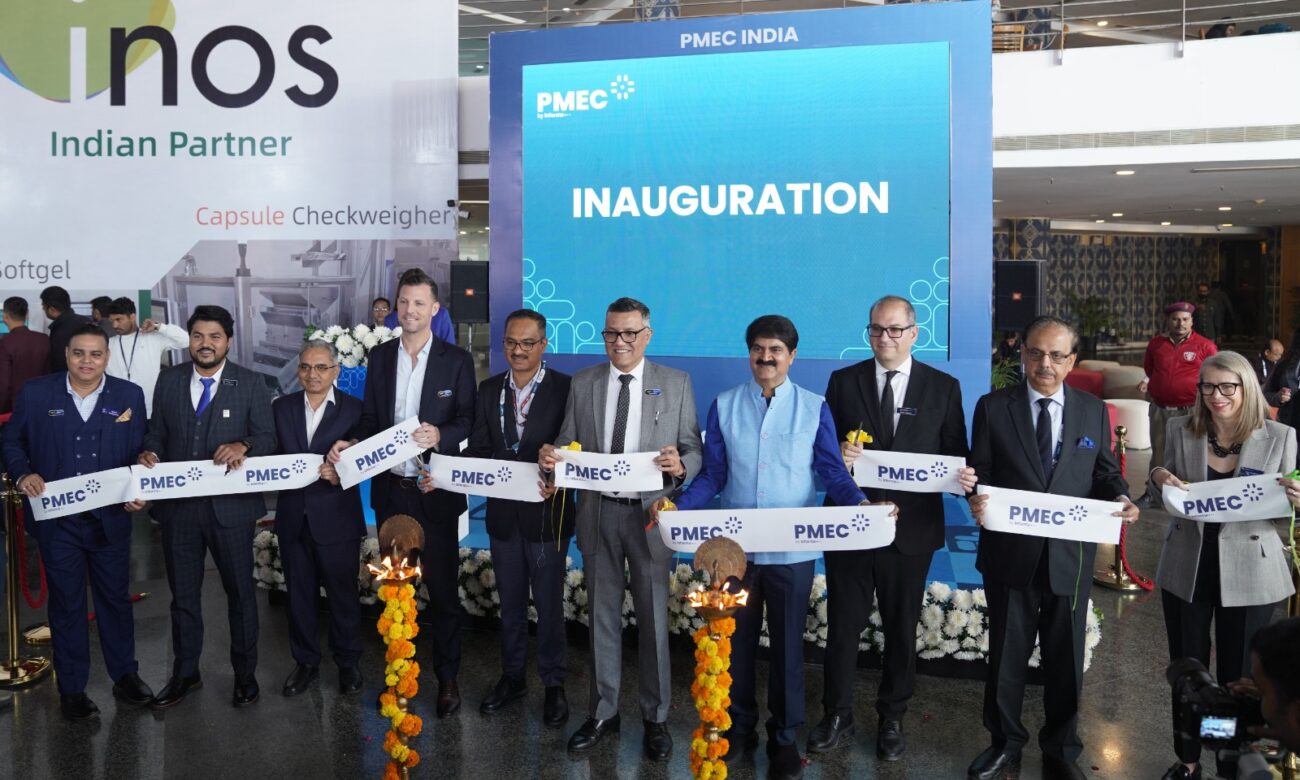
The grand inauguration was graced by an esteemed lineup of industry leaders, policymakers, and global representatives. The distinguished guests included Shri. Satyaprakash T L, IAS Joint Secretary Dept of Pharmaceuticals; Dr. Raj Shirumala, Senior Scientific Advisor, Dept of Pharmaceuticals; Mr. Orhan Caglayan – Executive Vice President – Pharma, Informa Markets B.V.; alongside Mr. Yogesh Mudras, Managing Director, Informa Markets in India and Mr. Rahul Deshpande, Sr. Group Director, Informa Markets in India.
Speaking at CPHI India 2026 Mr. Satyaprakash T. L., IAS, Joint Secretary, Department of Pharmaceuticals, said,“India’s position as the pharmacy of the world is reflected in its contribution of every fifth tablet consumed globally and every alternate tablet in the United States. Countries that have achieved technological leadership, such as Taiwan in semiconductors, Scandinavia in enzymes and the United States in Artificial intelligence have consistently invested in science and innovation. For India, pharmaceuticals represent a comparable strategic opportunity, but sustaining and intensifying it simultaneously, its global standing requires greater investment in advanced manufacturing technologies and indigenous machinery capabilities. PMEC India 2026 plays an important role in developing this ecosystem by connecting equipment manufacturers, facilitating technology exchange and enhancing the industry’s international competitiveness.”
Dr. Raj Shirumala, Senior Scientific Advisor, Department of Pharmaceuticals, Government of India, said, “Having established a strong global manufacturing presence, India’s pharmaceutical industry is poised to move beyond volume-driven growth towards higher-value innovation. Developing next-generation biologics, strengthening research capabilities and advancing high-value pharmaceuticals will be central to this transition. CPHI and PMEC India 2026 showcase the country’s scientific expertise and manufacturing strengths, creating opportunities to translate innovation into commercially viable products and technologies.”
Mr. Orhan Caglayan, Executive Vice President – Pharma, Informa Markets, said, “Global pharmaceutical manufacturing is navigating tariff pressures, margin compression and supply chain challenges, accelerating a shift from cost competitiveness towards quality, innovation and resilience. India is playing a pivotal role in this transition through growing investments in automation, AI, digitalisation and sustainable production. Over its 19-year journey, CPHI and PMEC India have evolved into a platform connecting the pharmaceutical value chain, from ingredients and formulations to machinery and manufacturing technologies. With CPHI India at Yashobhoomi and PMEC India in Greater Noida, the 2026 edition creates opportunities for technology exchange, global partnerships and advancing India’s pharmaceutical manufacturing capabilities.”
Mr. Yogesh Mudras, Managing Director, Informa Markets in India, said “India’s pharmaceutical industry continues to demonstrate strong manufacturing momentum, with annual turnover reaching ₹5.08 lakh crore in FY2025–26, registering an average growth of 9.2% over the preceding five years. Alongside this, domestic manufacturing of medical devices has expanded by approximately 48.2%, increasing from ₹28,000 crore in FY2019–20 to ₹41,500 crore in FY2024–25. These developments reflect India’s growing capabilities across the broader healthcare manufacturing ecosystem. The next phase of growth will depend on moving towards high-value segments such as advanced biologics, specialised therapies and complex formulations, supported by investments in advanced manufacturing infrastructure and technology. In this context, this year’s two-venue format of CPHI India and PMEC India marks an important evolution, bringing dedicated platforms for pharmaceutical ingredients and formulations, as well as machinery and manufacturing technologies, to facilitate focused industry engagement, stronger business connections and collaboration across the pharmaceutical value chain. Through this expanded platform, we aim to support innovation and strengthen India’s position in the global pharmaceutical ecosystem.”
Mr. Kunishetty Brahmanandam, Associate Vice President, Svan Analytical Instruments, said,“With an annual turnover of USD 300 million and an estimated 20–25% share of India’s aseptic solutions market, Svan is targeting 30–35% market penetration over the next two to three financial years. At PMEC India 2026, the company is showcasing Switzerland’s SafeFlex isolator, offering customised containment solutions for multi-product pharmaceutical manufacturing. However, rising global tariffs are increasing imported equipment costs by approximately 20–30%, placing additional pressure on manufacturers. Government support through import-duty relief or targeted subsidies could improve access to advanced technologies and strengthen India’s pharmaceutical manufacturing competitiveness.”
Mr. Jitu Panchal, Director, Sanitt Equipment & Machines, said, “As India’s pharmaceutical manufacturing sector expands, demand for GMP-compliant cleanroom infrastructure is driving greater emphasis on precision engineering, contamination control and operational efficiency. Sanitt has scaled its manufacturing capacity sixfold, from five tonnes to 30 tonnes per month, supported by a 25,000 sq. ft facility and a workforce of over 80 professionals. The next phase of growth will focus on advanced automation, CNC machining, modular cleanroom solutions and future integration of robotics and smart furniture technologies. PMEC India 2026 provides an important platform to engage with pharmaceutical manufacturers, understand evolving facility requirements and showcase customised solutions that combine regulatory compliance, faster deployment and long-term reliability.”
Mr. Ajay Mehta, Founder and Managing Director, GMP Technical Solutions Pvt. Ltd., said, “India’s cleanroom industry is witnessing rising demand from semiconductors, data centres, batteries and solar manufacturing, beyond its traditional pharmaceutical base. With annual revenue of approximately ₹500 crore and growth exceeding 20%, GMP Technical Solutions aims to reach ₹1,100 crore over the next five years. Non-pharma applications currently contribute 35% of revenue and are expected to exceed 50% within two years, while overseas projects account for nearly 30%. The pharmaceutical cleanroom market is estimated at ₹2,000–2,500 crore, with demand from other sectors projected to reach ₹6,000–7,000 crore in two years. At PMEC India 2026, the company is showcasing newly introduced washable risers designed to support stringent hygiene requirements during USFDA inspections.”
Mr C. M. Rao, Vice Chairman, iClean Integrated Cleanroom Technologies, said, “India’s cleanroom industry, estimated at ₹25,000 crore, is witnessing growing demand across pharmaceuticals, biotechnology and semiconductor manufacturing, with approximately 50–100 companies operating in the sector. Holding an estimated 10% market share and an annual turnover of ₹1,000 crore, iClean is targeting revenues of ₹2,500–3,000 crore over the next five years through product diversification and energy-efficient technologies. At PMEC India 2026, the company is showcasing its cleanroom interiors and equipment, including newly introduced biosafety cabinets and water showers. With over 2,600 installations and exports spanning 21 countries across the US, Europe, the Middle East, Asia and Africa, iClean is also exploring opportunities under India’s Semiconductor Mission 2.0. While the initiative recognises the importance of supporting industries, greater clarity on incentives and policy benefits will be crucial for cleanroom manufacturers. Having participated in PMEC India for all 19 editions, the exhibition remains an important industry engagement platform for the company.”
Industry Outlook
India’s pharmaceutical machinery and equipment sector is witnessing growing demand, supported by pharmaceutical manufacturing expansion, stricter quality requirements and increasing investments in modern production infrastructure. India’s pharmaceutical manufacturing equipment market is estimated at US$1.32 billion in 2026 and is projected to reach US$2.16 billion by 2031, growing at a CAGR of 8.6%. The implementation of stricter Good Manufacturing Practices (GMP) requirements is further encouraging manufacturers to upgrade processing equipment, automation systems, packaging lines and quality-control infrastructure. At the same time, the growing focus on biologics, complex formulations and export competitiveness is driving demand for specialised machinery, digitally integrated production systems and advanced manufacturing technologies.
By MedGate Bureau