
Pune’s First Female Cardiac Surgeon Transforms Recovery with Minimally Invasive Triple Vessel Bypass at Sahyadri Hospital
In a breakthrough that blends surgical precision with patient-centric innovation, doctors at Sahyadri Super Speciality Hospital, Deccan Gymkhana, have successfully treated a 48-year-old IT professional from Pune through a minimally invasive triple vessel coronary artery

In a breakthrough that blends surgical precision with patient-centric innovation, doctors at Sahyadri Super Speciality Hospital, Deccan Gymkhana, have successfully treated a 48-year-old IT professional from Pune through a minimally invasive triple vessel coronary artery bypass procedure. The surgery, performed on April 28, 2025, by Dr. Smruti Hindaria—Pune’s first female cardiac surgeon to use this advanced technique—marked a milestone in restoring cardiac function with minimal trauma and accelerated recovery.
The patient, Mr. Ramesh Korde (name changed), had been experiencing debilitating breathlessness for nearly three months, rendering him unable to perform even basic daily activities. Medical investigations, including coronary angiography, confirmed a diagnosis of critical triple vessel coronary artery disease—marked by significant blockages in all three major heart arteries. Compounding the concern was his reduced ejection fraction (EF)—a clinical indicator of how well the heart pumps blood—measured at just 35%, compared to the normal benchmark of 60%. Despite the severity of his condition, he was still operable, but expressed a strong aversion to undergoing traditional open-heart surgery via a full sternotomy.
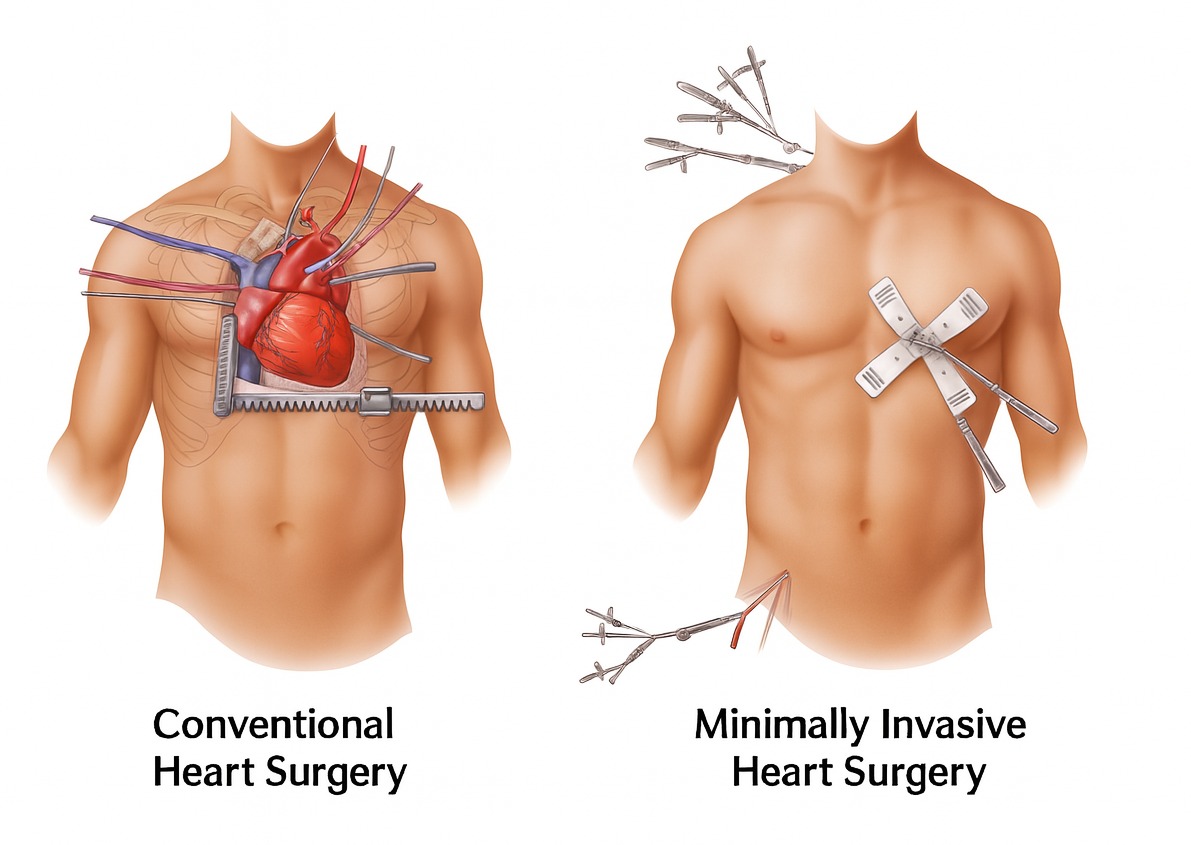
Considering his age, physical profile, and anatomical suitability, the surgical team recommended Minimally Invasive Coronary Artery Surgery (MICAS)—a contemporary alternative to conventional bypass surgery. “In MICAS, we avoid opening the chest through a midline cut,” explained Dr Smruti Hindaria. Consultant Cardiothoracic Surgeon, Sahyadri Super Speciality Hospital, Deccan Gymkhana. “Instead, we operate through a 2–3 inch incision made on the left side of the chest, navigating between the ribs without cutting through the breastbone. This approach significantly reduces trauma, pain, and blood loss—leading to a much faster recovery.”
In contrast to the conventional method—which typically involves a 10–12 inch incision, sternum cutting, 200–300 ml of blood loss, and a healing period of 6 to 8 weeks—MICAS offers substantial advantages. “We use long, specialized instruments through a small thoracotomy to gently retract muscle tissue and access the heart,” Dr. Hindaria said. “Since the bones remain untouched, most patients recover in 10 to 15 days, experience minimal pain, and require a shorter hospital stay. The scarring is barely visible.”
Mr. Korde’s postoperative course reflected these benefits—he was shifted out of the ICU within 48 hours and discharged from the hospital in just five days. “Such accelerated recovery is rare in traditional bypass cases, where hospitalization may extend to 7–10 days, with longer rehabilitation timelines,” the surgical team noted.
The successful surgery was executed with the support of a highly coordinated team including Dr. Shantanu Shastri (Cardiac Anesthetist), perfusionists who operated the heart-lung machine, physician assistants, and scrub nurses. The team emphasized that patient selection plays a critical role in MICAS outcomes. “We conduct a comprehensive preoperative evaluation that includes coronary angiography, 2D echocardiography, high-resolution CT scans of the heart, and pulmonary function tests,” said Dr. Shantanu Shastri, Cardiac Anesthetist, Sahyadri Super Speciality Hospital, Deccan Gymkhana. “These helped us assess not only the heart’s anatomy and artery accessibility but also lung capacity, which is crucial for single-lung ventilation during surgery.”
While MICAS is a transformative approach, it is not universally suitable. Patients with severely enlarged hearts, extremely low ejection fractions (under 25%), or those requiring concurrent procedures such as valve repair may not be eligible. Advanced age—particularly beyond 75 years—also introduces risks, especially in patients with fragile rib structures.
Dr. Hindaria sees MICAS as a stepping stone toward the next frontier in cardiovascular surgery. “This technique is not just about smaller incisions—it represents a mindset shift in cardiac care. We are moving toward a future where even more refined techniques, such as robotic-assisted and endoscopic cardiac surgeries, will redefine recovery and patient experience.”
As Sahyadri Hospitals continues to champion cutting-edge care with a focus on precision, speed, and empathy, the successful MICAS procedure underscores a larger trend: minimally invasive cardiac surgery is no longer a distant innovation but a present-day reality—offering renewed hope for patients unwilling or unable to undergo traditional open-heart procedures.