
With local manufacturing more than doubling to ~45% in three years, India’s MedTech sector is moving from import-dependence to a US$ 41–44 billion opportunity by 2030
Mumbai, 15th May 2026: India’s medical technology sector is entering a more strategic phase, moving beyond a market-size narrative toward a competitiveness narrative built on capability, quality, and global readiness. This is the key headline

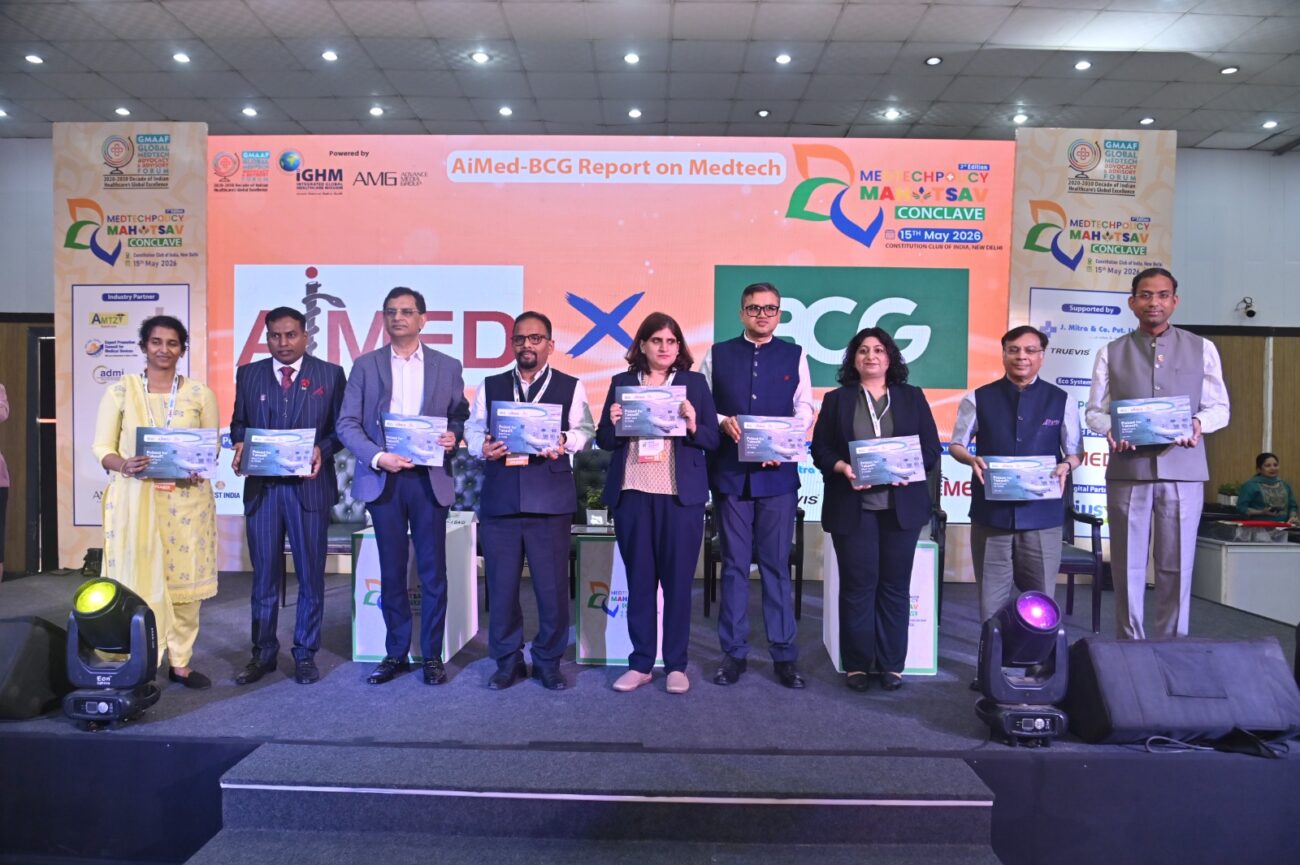
Mumbai, 15th May 2026: India’s medical technology sector is entering a more strategic phase, moving beyond a market-size narrative toward a competitiveness narrative built on capability, quality, and global readiness. This is the key headline from Poised for Takeoff: MedTech in India, a joint report by Boston Consulting Group (BCG), the Association of Indian Medical Device Industry (AiMeD), and the Kalam Institute of Health Technology (KIHT).
According to the report, India’s MedTech market has reached approximately US$ 16 billion and is growing at 13–15% annually, a pace that could scale the sector to US$ 41–44 billion by 2030 and US$ 83–89 billion by 2035. Domestic manufacturing’s share of local consumption has more than doubled from about 20% in 2022 to about 45% in 2025, growing at ~43% CAGR. Exports stand at approximately US$ 4 billion today and could scale to US$ 16–18 billion by 2035 as Indian-origin brands build credible quality systems and access regulated markets.
“Multiple structural tailwinds are propelling India’s transformation towards becoming a global medtech powerhouse, both from a make in India as well as innovate in India lens. This is going to create an opportunity for everyone, irrespective of your starting position, domestic incumbents, global medtech majors as well as new entrants to the sector,” said Vikash Agarwalla, Managing Director and Partner, BCG.
“For private capital investors, the coming decade could represent one of the most compelling value creation opportunities in Indian healthcare. The opportunity is not just to fund growth, but to help build MedTech champions that are trusted domestically, competitive globally, and scaled for long-term impact.”, said Roshni Rathi, Managing Director and Partner, BCG
The report identifies three distinct pillars shaping India’s ‘Make in India’ MedTech opportunity:
- India for India: The largest near-term pillar, serving domestic demand and replacing imports with indigenised products, is projected to grow from US$ 8 billion today to US$ 45–48 billion by 2035. Equipment and consumables lead the immediate ‘seize now’ opportunity, with IVD and devices scaling next.
- Export IP-led manufacturing: Indian companies are building their own brands for the US, EU, and LMIC markets. This pillar is projected to grow from US$ 4 billion today to US$ 16–18 billion by 2035, with export champions already scaling fast in cardiac and orthopaedic implants, IVD, and high-volume consumables.
- Contract manufacturing: Nascent today but projected to scale to ~US$ 7 billion by 2035 as global supply chains rebalance and OEMs diversify their manufacturing base. India’s existing strengths in software, sub-assembly, and polymer components offer a credible entry point.
Alongside ‘Make in India’, the report flags ‘Innovate in India’ as a powerful but currently underinvested second engine. India holds only ~3% of global MedTech patents, and Indian firms account for less than 1% of US FDA approvals between 2010 and 2025. Indian MedTech firms invest 2 – 4% of revenue on R&D, compared with 10–15% in the US and 15–20% in China. However, green shoots are visible: private equity and venture capital investment in Indian MedTech has scaled more than six-fold from US$ 180 million in 2019 to US$ 1.25 billion in 2025, and Indian challengers are emerging in high import-dependent segments such as helium-free MRI and soft-tissue surgical robotics.
“India can move from being a promising domestic market to becoming a globally trusted manufacturing and innovation base. The opportunity is not protectionism, but competitiveness; not only lower cost, but high-quality, patient-safe, globally benchmarked medical technology from India. The next phase will depend on rewarding real value-addition, enabling exporters to meet international expectations, and strengthening domestic adoption of Indian innovation,” said Rajiv Nath, Forum Co-ordinator, AiMeD.
The report notes that the shift is being supported by a broader policy and capital environment, including the National Medical Devices Policy, a ₹ 3,420 crore Production-Linked Incentive (PLI) scheme that has commissioned 24 projects across 57 products, four MedTech parks anchored by the Andhra Pradesh MedTech Zone (AMTZ), the launch of India’s first dedicated MedTech fund (MedArtha) by AMTZ in March 2026, and 100% FDI under the automatic route. Capital flows have also accelerated, with approximately ₹ 10,940 crore deployed across 230+ private equity, venture capital, and corporate transactions in 2025.
At the same time, the report cautions that India cannot scale on final assembly alone. A globally competitive MedTech ecosystem requires depth in components, medical-grade raw materials, testing, validation, sterilisation, clinical evidence, regulatory readiness, and post-market quality. Around 70–80% of high-value inputs, detectors, sensors, motors, printed circuit boards, specialty materials, and reagents, remain import-dependent, while inverted duty structures on critical inputs continue to undermine the viability of local manufacturing. MSMEs and growth-stage companies also face constraints around sequential approvals, certification costs, and access to scale capital.
“India’s MedTech trajectory will ultimately be defined not by sporadic ingenuity, but by our collective ability to architect a resilient, interoperable ecosystem that transforms innovation into enduring, equitable, and scalable impact. The momentum must now be anchored in the strengthening of end-to-end value chains, indigenisation of critical components, and calibrated regulatory harmonisation to unlock expanded access to global markets,” said Dr. Jitendra Sharma, Executive Director, KIHT.
Realising India’s MedTech potential will require coordinated action across four priority themes: building an ‘Atmanirbhar’ value chain ecosystem through incentives for tier-1 component suppliers and hub-and-spoke testing infrastructure aligned with FDA and EU MDR standards; strengthening policy and regulatory enablement through a single-window digital approvals portal, mutual recognition agreements with ASEAN and the EU, and fast-track pathways for breakthrough devices; attracting global MedTech OEMs and CDMOs through structured outreach and incentives linked to depth of domestic value addition; and strengthening foundational enablers around specialised talent and patient capital.
This report has been launched at the GMAAF MedTech Policy Mahotsav 2026, a forum that brings together industry leaders, policymakers, and experts to shape the future of MedTech.
The report concludes that India has scale, talent, entrepreneurship, frugal innovation, and significant healthcare needs, and that the window of opportunity now lies in combining these strengths with execution discipline, ecosystem coordination, and globally benchmarked quality. Done right, the next decade could see India transition from a promising domestic market to a credible global MedTech partner across manufacturing, innovation, and contract development.