
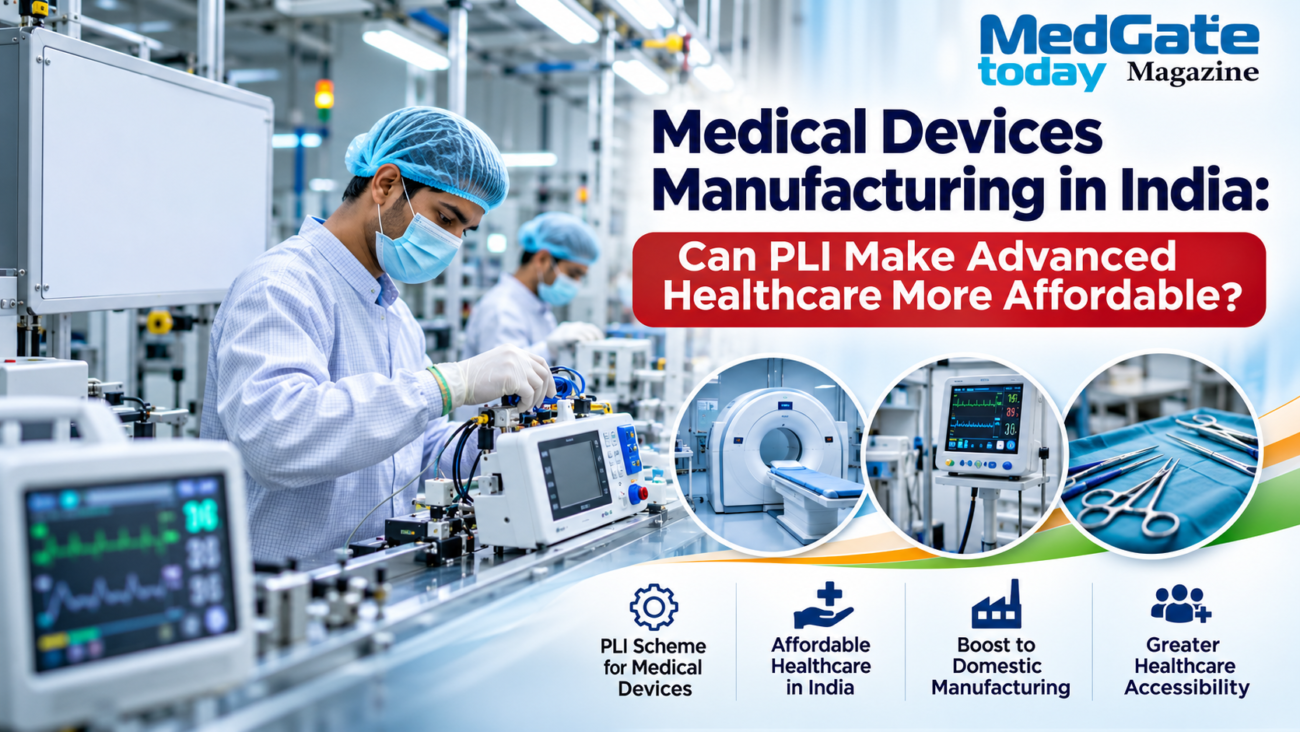
Medical Devices Manufacturing in India: Can PLI Make Advanced Healthcare More Affordable?
Healthcare News India is taking important steps towards becoming a global hub for medical technology and healthcare equipment manufacturing. With rising healthcare demand, increasing dependence on imported medical equipment and the need for affordable treatment, strengthening

India is taking important steps towards becoming a global hub for medical technology and healthcare equipment manufacturing. With rising healthcare demand, increasing dependence on imported medical equipment and the need for affordable treatment, strengthening domestic manufacturing has become a major priority. Government initiatives, particularly the Production Linked Incentive (PLI) Scheme, are expected to play an important role in accelerating this transformation.
The growing focus on Medical Devices Manufacturing in India reflects a broader ambition to make advanced healthcare technologies more accessible to hospitals, doctors and patients. From diagnostic imaging systems and surgical equipment to advanced implants and critical care devices, domestic production could help strengthen India’s healthcare infrastructure.
The government’s decision to extend the medical devices PLI initiative towards 2035–36 and introduce more flexible eligibility conditions has further highlighted the importance of long-term investment in this sector. However, an important question remains: Can increased domestic manufacturing actually reduce medical equipment costs and improve healthcare accessibility across the country?
Why Medical Devices Manufacturing in India Is Becoming a Priority
India has one of the world’s largest healthcare markets, supported by a growing population, increasing awareness of preventive healthcare and expanding hospital infrastructure. As healthcare facilities modernise, the demand for advanced medical equipment continues to increase.
However, a significant portion of sophisticated medical technology and specialised components has traditionally depended on international suppliers. This creates challenges for hospitals, particularly when global supply chains experience disruptions, currency fluctuations or changes in import prices.
Strengthening Medical Devices Manufacturing in India can help address these challenges by encouraging domestic companies to develop products locally.
Domestic manufacturing also creates opportunities for employment, research and development, technology transfer and industrial investment. More importantly, it can improve the availability of essential medical equipment in different parts of the country.
The government’s Make in India initiative has therefore become an important part of the country’s strategy to build a stronger and more self-reliant medical technology ecosystem.
How the PLI Scheme for Medical Devices Can Transform the Industry
The Production Linked Incentive (PLI) Scheme is designed to encourage companies to increase domestic production by providing financial incentives linked to eligible manufacturing performance.
The PLI Scheme for Medical Devices aims to attract investment, strengthen local manufacturing capabilities and reduce dependence on imported medical equipment and components.
Earlier, the government introduced dedicated support for domestic medical device manufacturing, including incentives for high-end medical equipment and critical components. The more recent policy push towards extending the programme to 2035–36 signals an intention to provide the industry with a longer investment horizon.
Encouraging Investment in Advanced Medical Technology
Manufacturing advanced medical equipment requires significant capital, specialised technology, skilled professionals and extensive research and development.
Financial incentives can make India a more attractive destination for domestic manufacturers as well as international companies looking to establish production facilities.
Companies may find greater opportunities to manufacture diagnostic equipment, imaging systems, electronic medical devices, surgical instruments and other specialised healthcare products within the country.
Supporting Domestic Manufacturers
Smaller manufacturers often face difficulties competing with established international companies because of higher production costs, limited research facilities and dependence on imported components.
A well-designed incentive structure can help domestic companies expand their operations, improve production efficiency and invest in modern manufacturing technologies.
However, long-term success will depend on transparent eligibility conditions, timely incentive payments and consistent government support.
Can Domestic Manufacturing Make Advanced Healthcare More Affordable?
Affordability is one of the biggest challenges facing India’s healthcare system. Advanced diagnostic equipment and specialised medical devices can involve substantial purchasing, installation and maintenance costs.
Increasing domestic production could help reduce some of these expenses by lowering dependence on imported finished products and improving supply chain efficiency.
For example, hospitals that purchase diagnostic imaging systems, patient monitoring equipment or surgical devices may benefit from greater competition among domestic suppliers.
However, domestic manufacturing does not automatically mean lower prices.
The actual cost of medical equipment depends on several factors, including raw materials, electronic components, research and development, quality certifications, maintenance requirements and distribution expenses.
If manufacturers continue depending on imported components, the overall cost advantage may remain limited.
Therefore, achieving Affordable Healthcare in India will require more than simply assembling imported products locally. Companies must gradually develop the ability to manufacture critical components, improve production quality and establish reliable after-sales service networks.
Make in India Medical Devices: Opportunities for the Healthcare Sector
The expansion of Make in India Medical Devices manufacturing presents opportunities across several segments of the healthcare industry.
Diagnostic and Imaging Equipment
Diagnostic technologies such as MRI scanners, CT systems, ultrasound machines and digital X-ray equipment are essential for modern healthcare facilities.
Developing domestic capabilities in these areas could improve equipment availability and encourage competition in the market.
Critical Care and Patient Monitoring Devices
Hospitals depend on ventilators, patient monitors, infusion pumps and other critical care equipment to manage patients requiring continuous medical attention.
Local production can strengthen supply reliability and support hospitals during emergencies.
Surgical Instruments and Medical Implants
Surgical instruments, orthopaedic implants, cardiovascular devices and other specialised products represent important opportunities for Indian manufacturers.
Developing high-quality domestic alternatives could provide hospitals with more purchasing options while supporting the growth of specialised manufacturing.
Medical Electronics and Advanced Components
One of the most important areas for long-term development is the manufacturing of components used in medical devices.
Sensors, semiconductors, imaging components, precision parts and specialised electronic systems are essential for advanced healthcare equipment.
Building domestic capabilities in these areas could reduce import dependence and strengthen India’s position in the global medical technology supply chain.
Medical Technology in India: Challenges That Need Attention
Despite the opportunities, the growth of Medical Technology in India faces several challenges that need a coordinated response from policymakers, manufacturers and healthcare institutions.
Dependence on imported components: Many advanced medical devices require specialised electronic components and technologies that are not yet manufactured at sufficient scale domestically.
High research and development costs: Developing advanced medical equipment requires substantial investment, clinical validation and technical expertise.
Quality and regulatory requirements: Medical devices must meet applicable safety, performance and regulatory standards. Manufacturers need to maintain consistent quality throughout the production process.
Shortage of specialised talent: The industry requires professionals with expertise in biomedical engineering, electronics, materials science, medical technology and product development.
Uneven market access: Smaller hospitals and healthcare facilities, particularly in rural and semi-urban areas, may struggle to purchase expensive medical equipment even when domestic alternatives become available.
Addressing these challenges will be essential to ensure that government incentives translate into sustainable industrial growth.
How Domestic Manufacturing Can Improve Healthcare Accessibility
The benefits of stronger domestic production should ultimately reach patients, not just manufacturers.
Improved local supply chains can help hospitals access essential equipment more reliably. Greater competition may also encourage manufacturers to introduce products at different price points, making technology more accessible to smaller healthcare facilities.
For example, district hospitals, diagnostic centres and smaller private hospitals could benefit from a wider selection of locally manufactured equipment.
This is particularly important for healthcare facilities operating outside major metropolitan cities, where equipment availability, maintenance support and replacement costs can become significant concerns.
Improving Healthcare Accessibility will also require investment in hospital infrastructure, trained healthcare professionals, equipment maintenance and affordable financing options.
The government, healthcare providers and medical device manufacturers must work together to ensure that technological progress reaches underserved communities.
What Should the Industry Focus on Next?
For the PLI initiative to deliver meaningful results, the next phase of Medical Devices Manufacturing in India should focus on building a complete manufacturing ecosystem rather than concentrating only on increasing production numbers.
Greater investment in research and development can help Indian companies develop innovative products suited to domestic healthcare requirements.
Manufacturers should also prioritise local component production, advanced testing facilities, quality assurance and collaboration with hospitals and research institutions.
Public-private partnerships can support technology development and encourage the exchange of technical expertise.
Another important priority is strengthening exports. Indian manufacturers that meet international quality standards could expand into overseas markets, creating additional revenue opportunities and improving the country’s global competitiveness.
Ultimately, the success of the PLI Scheme for Medical Devices should be measured through meaningful outcomes, including higher domestic value addition, reduced import dependence, competitive product pricing, improved product quality and wider availability of medical equipment.
FAQs
1. What is Medical Devices Manufacturing in India?
Medical Devices Manufacturing in India refers to the domestic production of healthcare equipment, diagnostic machines, surgical instruments, implants, patient monitoring systems and other medical technologies used for diagnosis, treatment and patient care.
2. What is the PLI Scheme for Medical Devices?
The PLI Scheme for Medical Devices is a government initiative designed to encourage domestic manufacturing through financial incentives linked to eligible production performance. Its objective is to attract investment, strengthen local capabilities and reduce dependence on imports.
3. Can domestic medical device manufacturing reduce healthcare costs?
Yes, domestic manufacturing has the potential to reduce certain costs by improving supply chain efficiency, encouraging competition and lowering dependence on imported finished products. However, actual price reductions depend on production costs, component sourcing and market competition.
4. How does Make in India support the medical technology industry?
The Make in India initiative encourages domestic investment, manufacturing, innovation and employment. In the medical technology sector, it supports efforts to develop local production capabilities and strengthen India’s position in the global medical device market.
5. How can medical device manufacturing improve healthcare accessibility?
Local manufacturing can improve equipment availability, strengthen supply chains and potentially make medical technologies more affordable. This can help hospitals, diagnostic centres and healthcare facilities expand access to quality medical services.
Conclusion: Can India Build an Affordable and Self-Reliant Medical Technology Industry?
India’s medical technology sector is entering an important phase of development. Government incentives, growing healthcare demand and increasing interest in domestic production are creating opportunities for manufacturers to expand their capabilities.
The Medical Devices Manufacturing in India initiative has the potential to strengthen the country’s healthcare infrastructure, reduce import dependence and encourage innovation in advanced medical equipment.
However, the real measure of success will not simply be the number of manufacturing facilities established or investments announced. It will be whether hospitals can access reliable, high-quality equipment at competitive prices and whether patients across different regions can benefit from improved healthcare services.
With sustained policy support, investment in research and development, stronger domestic supply chains and a focus on affordability, India can move closer to building a competitive and accessible medical technology ecosystem.
.
Disclaimer: This article is intended solely for general information and awareness and does not constitute professional advice, recommendation or endorsement; MedGate Today assumes no liability for decisions made based on its contents.