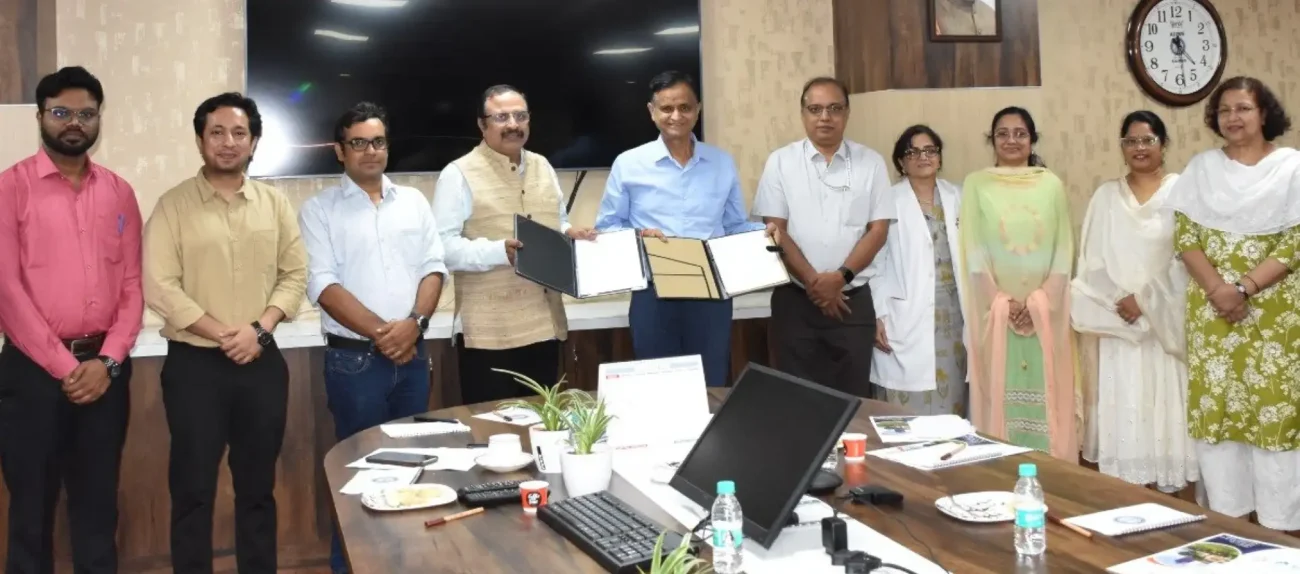

Defence Minister Rajnath Singh Inaugurates Mahajan Imaging & Labs’ Integrated Centre of Excellence in Diagnostics in Noida, Calls Preventive Healthcare the Future
Calls for India's healthcare model to shift from treatment to prevention, with timely screening and early diagnosis at the centre Highlights India's opportunity to lead healthcare innovation by combining AI, advanced imaging, molecular diagnostics and digital


Calls for India’s healthcare model to shift from treatment to prevention, with timely screening and early diagnosis at the centre
Highlights India’s opportunity to lead healthcare innovation by combining AI, advanced imaging, molecular diagnostics and digital health with medical expertise and compassion
Notes that more than 5 crore people have been connected through Ayushman Bharat, with over 80 lakh beneficiaries in Uttar Pradesh receiving healthcare support
Says bringing advanced diagnostic capabilities closer to people can strengthen access to specialised healthcare and support a healthier, stronger India
Noida, 22nd August 2026: Mahajan Imaging & Labs has expanded its diagnostic services to Uttar Pradesh with the launch of an Integrated Centre of Excellence in Diagnostics in Noida, as early detection and timely diagnosis become increasingly important to healthcare delivery. The facility brings together advanced imaging, pathology, genomics, molecular diagnostics and personalised health assessments at one location, serving patients from Noida, western Uttar Pradesh and the Delhi NCR. The centre was inaugurated by Hon’ble Defence Minister of India, Shri Rajnath Singh, who lit the ceremonial lamp along with Member of Parliament from Gautam Buddh Nagar, Dr Mahesh Sharma; former Cabinet Secretary Rajiv Gauba; Member of NITI Aayog, television anchor and journalist Rajat Sharma; MLA Bansuri Swaraj; actor Sharmila Tagore and other dignitaries present at the occasion.
The expansion comes against a broader shift in India’s healthcare priorities towards prevention, early diagnosis and stronger health infrastructure. In his March 2026 address at the Post-Budget Webinar on Health, Prime Minister Narendra Modi highlighted the need to strengthen healthcare infrastructure and move towards preventive and holistic healthcare, including early diagnosis. This assumes greater significance as non-communicable diseases account for 63% of deaths in India, with cardiovascular diseases, cancers, diabetes and chronic respiratory diseases among the leading contributors. The government has expanded the national NCD network to 770 District NCD Clinics, 6,410 NCD clinics at Community Health Centres and 233 Cardiac Care Units, reflecting the wider shift towards earlier detection and management of disease. This shift is also increasing the importance of timely and accurate diagnostics in supporting early detection, clinical decision-making and treatment planning.
The newly launched centre includes Uttar Pradesh’s first Ultra-Fast AI-powered 3T MRI scanner, the Excel 3T, along with a 160-slice CT scanner. Other imaging services include 3D-4D ultrasound, Colour Doppler, shear-wave elastography, full-field digital mammography, DEXA bone densitometry, CBCT/OPG and digital X-ray, while neurophysiology services include EEG and EMG. The centre also offers comprehensive pathology services across hematology, clinical biochemistry, microbiology, serology, immunology, histopathology and cytology, along with next-generation sequencing (NGS), molecular diagnostics, genomics and personalised health assessments.
Speaking at the inauguration, Hon’ble Defence Minister of India, Shri Rajnath Singh, said, “India’s healthcare model must increasingly move from treatment to prevention. Preventive healthcare is the future, and timely screening and early diagnosis will play a critical role in reducing the growing burden of non-communicable diseases. Treating illnesses at an advanced stage not only places a greater burden on patients and families but also increases pressure on the healthcare system and the economy. Through initiatives such as Ayushman Bharat, India has made significant progress in expanding access to healthcare. More than 5 crore people have been connected through the programme, and in Uttar Pradesh alone, over 80 lakh beneficiaries have received healthcare support. The next phase of India’s healthcare journey must now focus on keeping people healthier and identifying health risks before they develop into serious medical conditions. India has a unique opportunity today, with talented doctors and scientists, strong technology capabilities and a healthcare sector that is increasingly embracing innovation. Artificial intelligence, advanced imaging, molecular diagnostics and digital health can strengthen this approach, provided technology continues to work alongside medical expertise and human compassion. India should not merely follow global healthcare trends but help lead the next phase of healthcare innovation by combining scientific excellence with accessibility and compassion. The availability of advanced diagnostic capabilities closer to people in Uttar Pradesh will strengthen access to specialised healthcare and support the state’s wider healthcare ecosystem. A healthier and stronger India will be an important foundation for the vision of Viksit Bharat.”
Padma Shri Dr Harsh Mahajan, Founder & Chairman, Mahajan Imaging & Labs and Mentor, FICCI Health Services Committee, said, “For more than 35 years, our journey has been shaped by the many changes we have witnessed in medicine, technology and diagnostic healthcare. This occasion is not simply about adding another centre to our network, but about taking the experience, expertise and trust we have built over the years closer to more people. Diagnostics today can help us identify disease earlier, understand it in greater detail and guide treatment with far greater precision. Yet, its fundamental purpose remains unchanged. A patient comes to us seeking answers, and a doctor comes to us seeking clarity. Our responsibility is to provide both with information that is accurate, clinically meaningful and delivered with sensitivity. Technology alone does not create excellence. Its real value comes when it is combined with experienced professionals, strong clinical understanding and a sense of responsibility towards every patient. Our endeavour has therefore always been to bring different areas of diagnostic expertise together so that they complement one another and help provide a clearer and more complete picture for doctors and patients.”
Mrs. Ritu Mahajan, Co-Founder and Executive Director, Mahajan Imaging & Labs, said, “When we began designing our new centre at Spectrum Mall, Sector 75, Noida, I wanted it to feel different from a conventional medical space. The décor draws from Indian culture and the traditions of Uttar Pradesh, with elements of our rich heritage reflected throughout the interiors. At the same time, the space has been created to bring a sense of calm, warmth and privacy for patients. People often arrive at a diagnostic centre carrying anxiety and uncertainty while waiting for answers, and I have always believed that the surroundings can influence how they experience that journey. The idea was to create a space that feels welcoming and reassuring, where patients feel cared for from the moment they walk in. This is part of a larger vision of bringing medical excellence and advanced technology together with compassion, trust and dignity for every patient.”
Mahajan Imaging & Labs has built its expertise across radiology, genomics, pathology, molecular diagnostics and personalised health checks. The organisation has also undertaken clinical and applied research with institutions including the Massachusetts Institute of Technology (MIT), Max Planck Institute, All India Institute of Medical Sciences (AIIMS) and Indian Institute of Technology (IIT) Delhi.
The Noida launch marks Mahajan Imaging & Labs’ first facility in Uttar Pradesh and an important step in its expansion across the region. It also strengthens the organisation’s presence in one of the NCR’s fastest-growing healthcare markets and extends its integrated diagnostic model to a wider patient population.