

Indian hospitals should work on establishing basic minimum standard for patient safety and quality care to act as benchmark: Member, NITI Aayog
Ayushman Bharat Digital data going to be a gamechanger, allowing us to achieve transformative outcomes not only for the nation but also for the Global South Prof Dr M Srinivas, Member, NITI Aayog today urged the

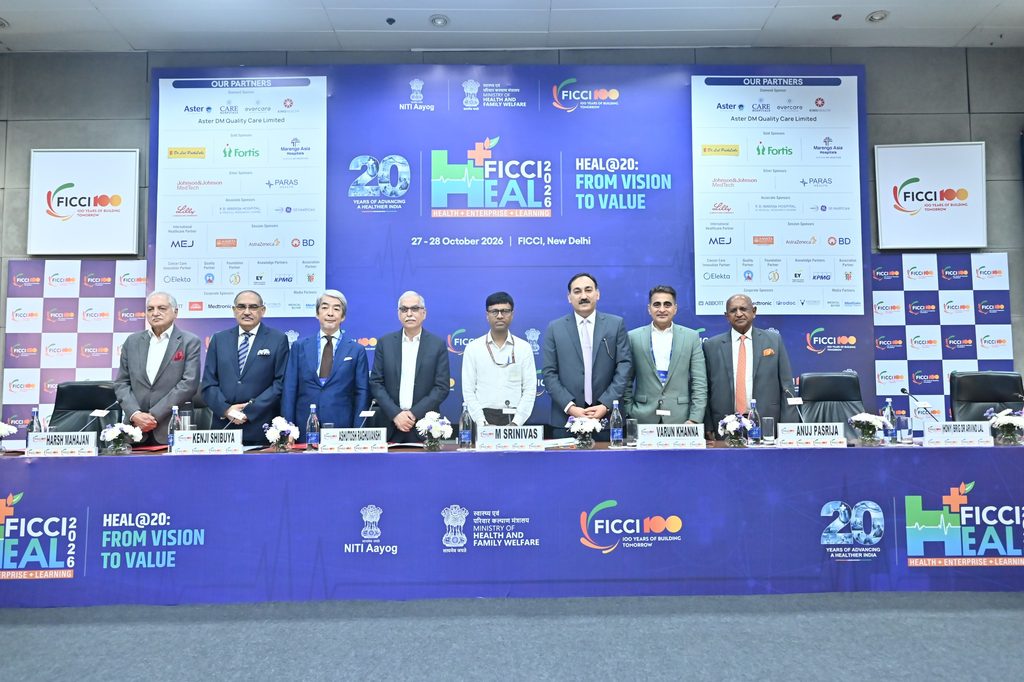
Ayushman Bharat Digital data going to be a gamechanger, allowing us to achieve transformative outcomes not only for the nation but also for the Global South
Prof Dr M Srinivas, Member, NITI Aayog today urged the hospitals to not just focus on patient care but enhance patient safety and quality standard. “The country should have a basic minimum standard of quality and safety at every hospital. As a country, we must come to a level where the world should recognize that Indian hospitals have a minimum standard of patient care,” he emphasized.
Addressing the 20th edition of ‘FICCI HEAL 2026’, on the theme – ‘HEAL@20: From Vision to Value’, Prof Srinivas said that through the Ayushman Bharat Digital Mission, we have created a robust digital health ecosystem. This is going to be a gamechanger because data is a goldmine for us. Once this data is harnessed, AI can be optimally utilized, allowing us to achieve transformative outcomes not only for the nation but also for the Global South. “Through the National Health Authority, we are coming out with structured data with interoperability, like one nation one election. We will have one platform of ABHA id and electronic health records which will be interoperable. That’s something which we are pushing for,” he added.
Prof Srinivas further stated that placing people at the center of the healthcare system is the key by giving the right treatment at the right time and protecting from extra financial burden which is the focus of PM-JAY. “We have seen an increasing number of non-communicable diseases, we must focus on preventing these diseases rather than just treating them at tertiary care hospitals,” he noted.
Speaking on the patient care, Prof Srinivas stated that there is a need to have a match of both hospital and hospitality at government as well as private hospitals. There is a need for the private hospitals to adopt the universal health scheme, he noted and urged the private hospitals to extend affordable healthcare to tier-2 and 3 cities as well to avoid unequal distribution of care.
Dr Kenji Shibuya, CEO, Medical Excellence JAPAN (MEJ) said, “India and Japan have a unique opportunity to lead the healthcare transformation together. India’s vision of ‘Heal in India’ is truly inspiring. By integrating advanced medical care, Ayurveda, and wellness awareness, India is positioning itself as a global healing destination.”
Dr Ashutosh Raghuvanshi, Chair, FICCI Health Services Committee and MD & CEO, Fortis Healthcare said, “As we look towards Viksit Bharat 2047, the healthcare sector must work towards a system that combines world-class capabilities with affordability, access, and trust. This will require sustained investment, stronger prevention and early diagnosis, a skilled healthcare workforce, and closer collaboration across the public and private sectors.”
Mr Anuj Pasrija, Country Lead, J&J MedTech India & VP-Surgery, Johnson & Johnson said, “Hospital of the future will not be defined merely by its buildings, beds, or operating rooms. It will be defined by its ability to stay connected with the patient across the entire journey of patient care.”
Mr Varun Khanna, Co-Chair, FICCI Health Services Committee and MD & Group CEO, Aster DM Quality Care Ltd said, “As we celebrate 20 years of FICCI HEAL, let us renew our commitment to building a healthcare system that is more accessible, affordable, equitable, innovative, and focused on delivering value and quality to every single patient.”