
3rd MedTech Policy Mahotsav 2026 Concludes in New Delhi with Strong Policy Consensus on Regulatory Harmonisation, Quality Compliance & Export Readiness for a Self-Reliant MedTech India
“Poised for Takeoff: MedTech in India” report launched at the national policy platform attended by over 450 delegates and 70+ eminent speakers from government, industry, research institutions, and healthcare ecosystems The 3rd Edition of MedTech Policy

“Poised for Takeoff: MedTech in India” report launched at the national policy platform attended by over 450 delegates and 70+ eminent speakers from government, industry, research institutions, and healthcare ecosystems
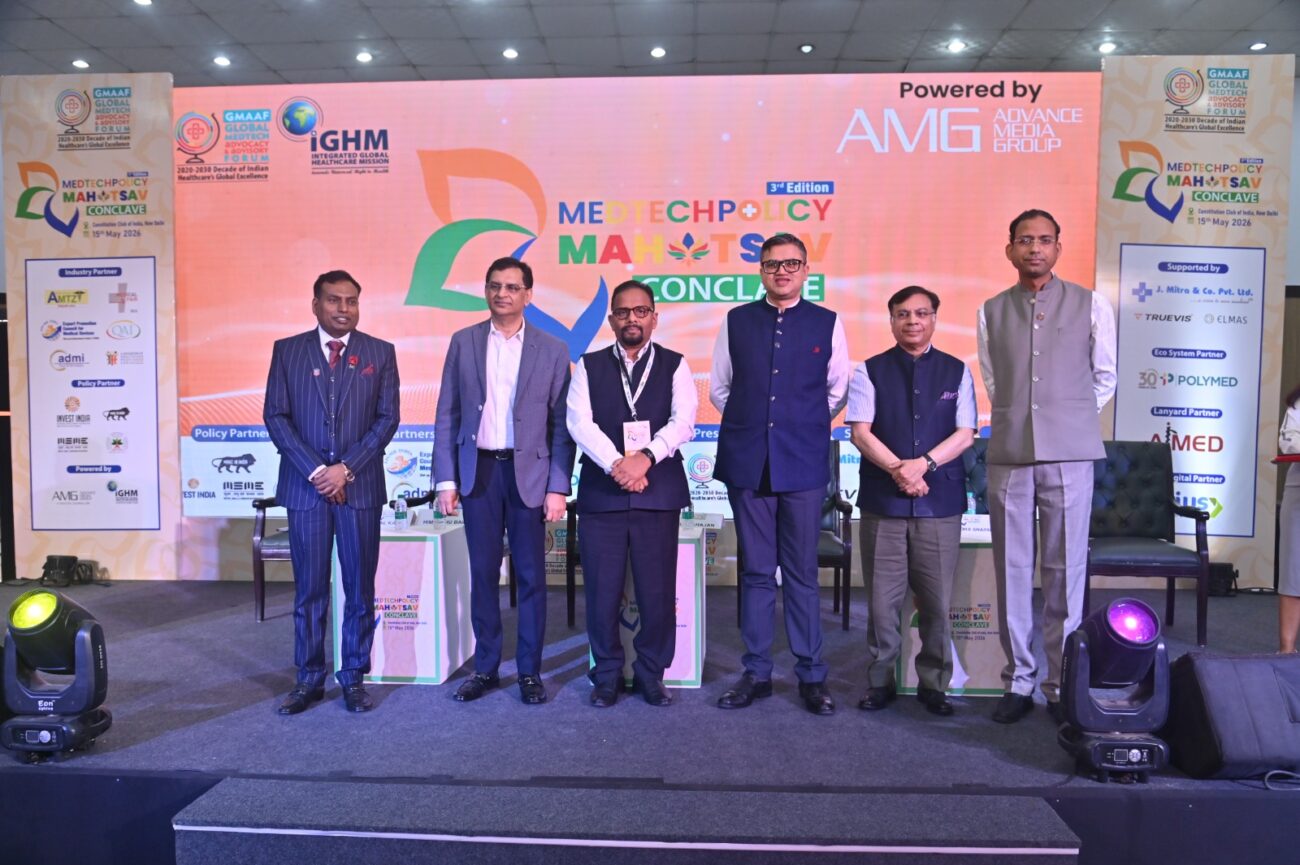
The 3rd Edition of MedTech Policy Mahotsav 2026, organized by Global MedTech Advocacy & Advisory Forum (GMAAF), concluded successfully on 15 May 2026 at the Constitution Club of India, New Delhi.
Held under the theme, “Ease of Doing Business to Global Leadership: Harmonisation, Quality Compliance & Export Readiness for a Self-Reliant MedTech India@2047,” the Mahotsav brought together more than 450 delegates and over 70 eminent speakers, including senior government officials, regulators, policymakers, healthcare leaders, MedTech manufacturers, innovators, investors, research institutions, startups, and industry associations from across India.
The event emerged as a significant national policy convergence platform focused on accelerating India’s transition from a developing MedTech market to a globally competitive manufacturing and innovation powerhouse aligned with the vision of Viksit Bharat@2047.
The inaugural session was graced by distinguished dignitaries participating in the conference included Aseem Sahu as Guest of Honour; Afzal Kamal as Mentor & Patron, Jatin Mahajan as Conference Chair; and Himanshu Baid as Keynote Speaker.
The conference was further graced by the presence of Dr. G. N. Singh, who highlighted the need for globally harmonized regulatory systems and robust quality assurance mechanisms to strengthen India’s global MedTech positioning.
Senior representatives from Indian Council of Medical Research (ICMR) also participated in the deliberations, including Dr. Ashoo Grover, Deputy Director General and Taruna Madan Gupta, emphasizing the importance of research driven innovation, indigenous technologies, and evidence based healthcare ecosystems.
Representatives from accreditation and quality ecosystems, including senior leadership from National Accreditation Board for Certification Bodies (NABCB), also participated in the discussions focused on quality compliance and international benchmarking.
A major highlight of the event was the launch of the strategic industry report titled “Poised for Takeoff: MedTech in India”, jointly presented through the AiMeD BCG collaboration. The report outlined critical recommendations for strengthening India’s MedTech manufacturing ecosystem, reducing import dependency, enhancing regulatory agility, improving global competitiveness, and accelerating export readiness.
The report launch was led by Rajiv Nath and Dr. Jitendra Sharma, both of whom delivered strategic insights on India’s MedTech growth trajectory.
Addressing the gathering, Mr. Aseem Sahu underscored the importance of patient safety, regulatory transparency, and internationally aligned compliance frameworks. He reiterated CDSCO’s commitment towards enabling a balanced regulatory environment that supports innovation while ensuring quality and safety standards.
Keynote Speaker Himanshu Baid emphasized the importance of strengthening domestic manufacturing resilience and building globally competitive Indian MedTech brands capable of serving both domestic and international healthcare markets.
Speaking during the session, Rajiv Nath stated that India now stands at a defining moment where policy simplification, quality compliance, and manufacturing competitiveness must move together to establish the country as a trusted global MedTech supplier. He emphasized that collaborative policymaking and institutional convergence would be critical in achieving long-term sectoral growth.
Dr. Jitendra Sharma highlighted the need for strengthening innovation ecosystems, MedTech parks, testing infrastructure, and research driven manufacturing capabilities. He noted that India possesses the potential to emerge as a global hub for affordable and high quality medical technologies if supported by integrated policy and infrastructure reforms.
The conference was organized against the backdrop of India’s rapidly evolving MedTech landscape, shaped by increasing healthcare demand, the government’s push towards domestic manufacturing, and shifting global supply chains. Discussions throughout the Mahotsav highlighted existing sectoral challenges including regulatory fragmentation, import dependency, export barriers, and gaps in global quality alignment.
The event featured a series of keynote addresses, leadership roundtables, policy dialogues, strategic discussions, and industry showcases covering critical policy and industry themes shaping the future of India’s MedTech ecosystem.
Key deliberations included “India@2047 & the MedTech Imperative: From Regulatory Reform to Global Manufacturing Leadership,” which focused on India’s long term MedTech vision, healthcare resilience, domestic manufacturing expansion, and global supply chain opportunities.
The inaugural power panel on “MedTech Policy: Aligning Regulation, Industrial Strategy & Export Ambition for Viksit Bharat” emphasized the need for synchronized policy frameworks, innovation friendly regulations, institutional convergence, and export driven industrial growth.
Extensive discussions were also held on Regulatory Harmonisation & Ease of Doing Business, focusing on simplifying licensing pathways, streamlining compliance procedures under India’s MDR framework, reducing regulatory duplication, and enabling risk based approval mechanisms for manufacturers and startups.
Sessions on Quality Compliance to Global Acceptance highlighted the importance of aligning Indian quality systems with international benchmarks such as USFDA, EU MDR, and ISO standards. Experts discussed strengthening testing laboratories, accreditation ecosystems, certification infrastructure, clinical validation pathways, and audit preparedness for Indian manufacturers.
The panel on Pricing, Procurement & Ethical Market Access deliberated on balancing affordability with innovation and quality manufacturing. Discussions emphasized the transition from lowest-cost procurement models towards value based healthcare procurement systems focused on patient outcomes, transparency, and sustainable innovation.
A major focus area during the conference was Diagnostics, AI & Emerging Technologies, where experts explored regulatory preparedness for AI-enabled medical devices, Software as a Medical Device (SaMD), digital therapeutics, cybersecurity frameworks, patient data privacy, and integration with India’s digital health ecosystem.
The session on Reimagining Price Regulation in Healthcare examined the need for transparent, evidence based pricing frameworks, value based pricing models, Health Technology Assessment (HTA), and rationalized reimbursement systems to ensure patient affordability while sustaining innovation and industry growth.
The Grand Concluding Policy Dialogue on Export Readiness & Global Competitiveness emphasized strengthening India’s export ecosystem through international regulatory credibility, manufacturing scalability, trade facilitation, global certifications, logistics resilience, and strategic positioning of Indian MedTech products within global healthcare supply chains.
The Mahotsav witnessed participation from leading institutions and stakeholders including NITI Aayog, Central Drugs Standard Control Organization (CDSCO), Department for Promotion of Industry and Internal Trade (DPIIT), Association of Indian Medical Device Industry (AiMeD), Confederation of Indian Industry (CII), Federation of Indian Chambers of Commerce & Industry (FICCI), research institutions, healthcare organizations, startups, investors, and manufacturing leaders.
A significant highlight of the conclave was the official MoU Signing Ceremony between the Department of Architecture & Planning, Indira Gandhi Delhi Technical University for Women (IGDTUW) and Healthcare Planning & Infrastructure Expo (HPIE) under the banner of Advanced Media Group.
The strategic collaboration marked an important step towards strengthening healthcare infrastructure innovation, academic industry engagement, policy dialogue, research collaboration, and future ready healthcare planning in India.
The deliberations reflected a collective consensus that India’s MedTech sector must evolve through coordinated policy reforms, stronger public private collaboration, globally benchmarked quality systems, and export oriented manufacturing strategies.
As part of the conference outcomes, the key recommendations emerging from the deliberations will be consolidated into a Policy Recommendation Charter and strategic reform roadmap for submission to relevant ministries, regulators, and institutional stakeholders.
The successful conclusion of the 3rd MedTech Policy Mahotsav further reinforced its role as one of India’s leading national platforms driving dialogue, policy advancement, innovation, and strategic collaboration for the future of India’s MedTech ecosystem.