
Second Chance at Life: Spine Surgery Helps Woman Walk Again After Paralysis from Fall
An 89-year-old woman, left completely paralyzed after a fall, regains movement and independence following complex spine surgery and intensive recovery care In a deeply emotional and challenging case, Dr. Amit Sharma, Spine Surgeon, Neo Spine Clinic, Mumbai,

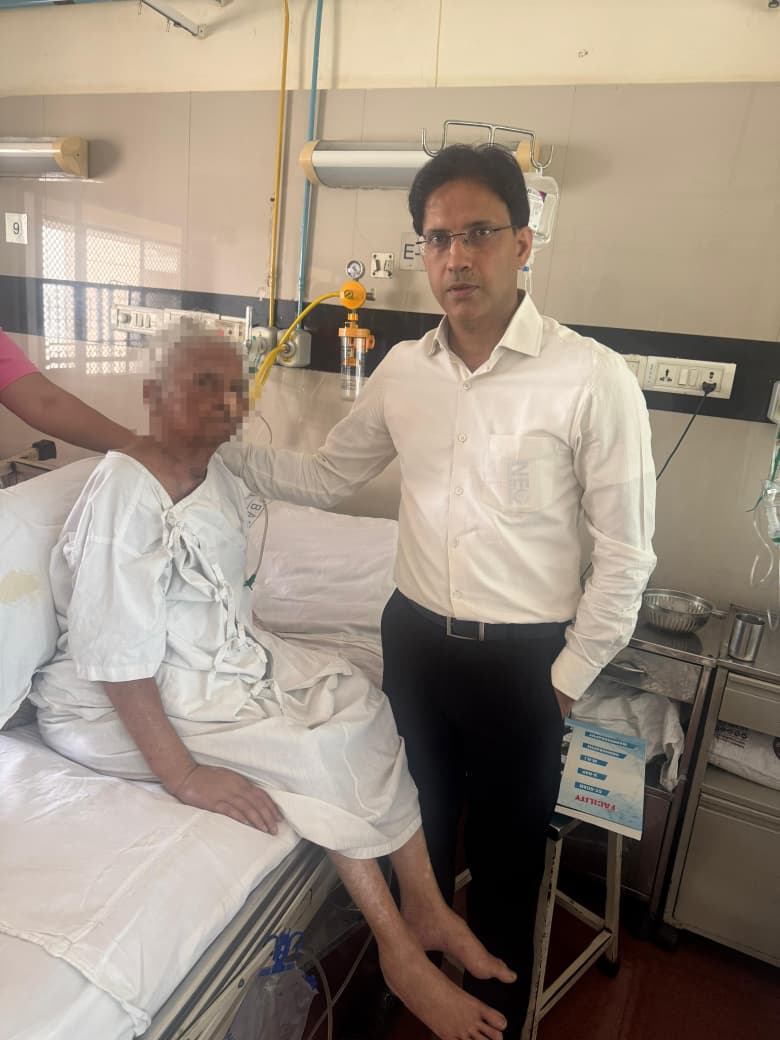
An 89-year-old woman, left completely paralyzed after a fall, regains movement and independence following complex spine surgery and intensive recovery care
In a deeply emotional and challenging case, Dr. Amit Sharma, Spine Surgeon, Neo Spine Clinic, Mumbai, helped an 89-year-old woman regain movement and independence after she was left completely paralyzed following a fall at home. The surgery was performed at Jaslok Hospital, Mumbai. What began as a simple accident quickly turned into a life-threatening condition, leaving her unable to move her arms or legs and entirely dependent on others for basic needs.
The patient Shanti Singh (name changed), an 89-year-old resident of Chembur, Mumbai, had always been the pillar of strength for her family. She suffered a fall at home, which led to a serious cervical spine (neck) injury. After the fall, her life changed overnight. She was left completely paralyzed, unable to sit, eat, or even breathe comfortably without support. Once fiercely independent, she found herself entirely dependent on her loved ones for even the smallest needs, which deeply affected her emotionally. The loss of independence was harder for her than the pain itself. Watching her struggle and lose hope was heartbreaking for the family, who were left feeling helpless and uncertain about her future. After consulting various specialists without adequate relief or a definitive plan, the family approached Dr. Amit Sharma at Neo Spine Clinic, seeking expert intervention for this critical condition.
Dr. Amit Sharma, Spine Surgeon, Neo Spine Clinic, said, “When the patient arrived, she was in a critical condition. She was completely unable to move her arms and legs and was also experiencing significant difficulty in breathing, a direct consequence of the severe spinal cord injury. On detailed evaluation with MRI, CT scan, and X-rays, we identified a complex fracture at the C5-C6 level of the cervical spine along with significant spinal cord damage. The investigations also revealed a condition called Diffuse Idiopathic Skeletal Hyperostosis (DISH), a condition where the spine becomes abnormally rigid and stiff due to bony overgrowth, making it highly prone to fractures even with minor trauma. In simple terms, think of a normal spine as a flexible bamboo stick; it bends and absorbs impact. A spine affected by DISH is like a dry, brittle stick. When it breaks, it doesn’t just crack partially; it often snaps with far greater force, causing severe trauma to the spinal cord. In this patient’s case, even a seemingly minor fall at home was enough to cause a catastrophic fracture and injury to the spinal cord, cutting off communication between the brain and the rest of the body.”
Dr. Sharma further added, “Given her age and the severity of the injury, the situation was extremely challenging. The key challenges we faced were multiple: her advanced age of 89 years came with several medical co
morbidities that needed careful management; osteoporosis, the thinning and weakening of bones that is common in the elderly significantly reduced the ability of the screws to grip the bone firmly during fixation; the injury itself was complex and demanded a highly technical surgical approach; there was a very high likelihood that she might not recover well given the nature and severity of the spinal cord injury; and elderly patients generally have a reduced ability for spinal cord recovery compared to younger individuals. Without timely intervention, she was at high risk of life-threatening complications such as pneumonia, bedsores, and serious infections due to prolonged immobility.”
After careful evaluation and discussions with the family, we decided to proceed with surgery to stabilize the spine and relieve pressure on the spinal cord. However, the patient first required four days of medical stabilization before she was fit enough to undergo the procedure. The patient then underwent a complex posterior cervical decompression and stabilization surgery. In simple terms, this involved approaching the spine from the back of the neck, carefully removing the bone and tissue that was pressing on the spinal cord to relieve the pressure (decompression), and then fixing the fractured vertebrae together using rods and screws to stabilize the spine (fixation), both to provide immediate stability and to allow the bones to fuse and heal in the correct position over the long term. The surgery lasted approximately four to five hours and was performed without any intraoperative complications.
However, the journey did not end there. The post-operative phase required intensive care, including ventilator support for 10 days and close monitoring in the ICU. The tracheostomy tube, which had been placed to assist her breathing, was successfully removed at two and a half weeks. She was discharged from the hospital approximately three weeks after surgery, with a cervical collar (neck brace) prescribed to support and protect the spine during healing. Gradually, signs of recovery began to appear.”
Dr. Sharma added, “Recovery in such cases is often slow and uncertain, especially in elderly patients. But this patient showed remarkable courage. Within weeks, we began to see small but encouraging improvements. From initial minimal movement, she gradually regained strength in her limbs. With structured rehabilitation and continuous support, she was able to sit up, eat on her own, and eventually move with assistance. Within six weeks, the transformation was remarkable. The patient regained strength in her arms and legs, could breathe independently, and was able to spend time in a wheelchair instead of being confined to a bed. More importantly, she regained her confidence, independence, and emotional well-being. At her one-month follow-up, she has shown significant and encouraging recovery; she can sit up by herself, breathe independently without any support, and has good motor recovery in both her arms and legs. She is doing well and continuing to improve with ongoing rehabilitation.”
Expressing their gratitude, the family said, “We had almost lost hope when she was completely paralyzed. Seeing her smile, speak, and move again feels like a miracle. We are thankful to Dr. Amit Sharma for giving her a second chance at life.”
This case highlights that age alone should not be a barrier to advanced medical care. With timely intervention, expert surgical management, and dedicated rehabilitation, even severe conditions can be treated effectively. For this 89-year-old woman, it was not just a medical recovery; it was a return to life, dignity, and the warmth of her family.