
India’s medical moonshot-AINU’s Surgeon performs Urology Robotic Telesurgery from Wuhan (China) on patient in Hyderabad (India)
Pioneering long-distance precision, the landmark procedure showcases the future of Robotic Uro- Oncology care in India In a landmark achievement for Indian healthcare and surgical innovation, a senior surgeon at the Asian Institute of Nephrology and Urology (AINU)

Pioneering long-distance precision, the landmark procedure showcases the future of Robotic Uro-
Oncology care in India
In a landmark achievement for Indian healthcare and surgical innovation,
a senior surgeon at the Asian Institute of Nephrology and Urology (AINU) – India’s largest single
speciality on Urology and Nephrology hospital chain has successfully performed a remote robotic
assisted surgery on a patient located over 3900 kilometres (by air) away, demonstrating the
transformative potential of tele surgery in delivering expert care across geographical boundaries.
Robotic surgery has transformed care by improving precision and accelerating surgeon proficiency,
but the real challenge remains building skilled talent beyond urban centres. With 5G-enabled
connectivity, the future lies in tele proctoring where experts remotely guide surgeons during
critical steps. This hub and spoke model enhances access, reduces travel, and strengthens local
capabilities, while ensuring that accountability and patient care always remain firmly in the hands of
the operating surgeon.
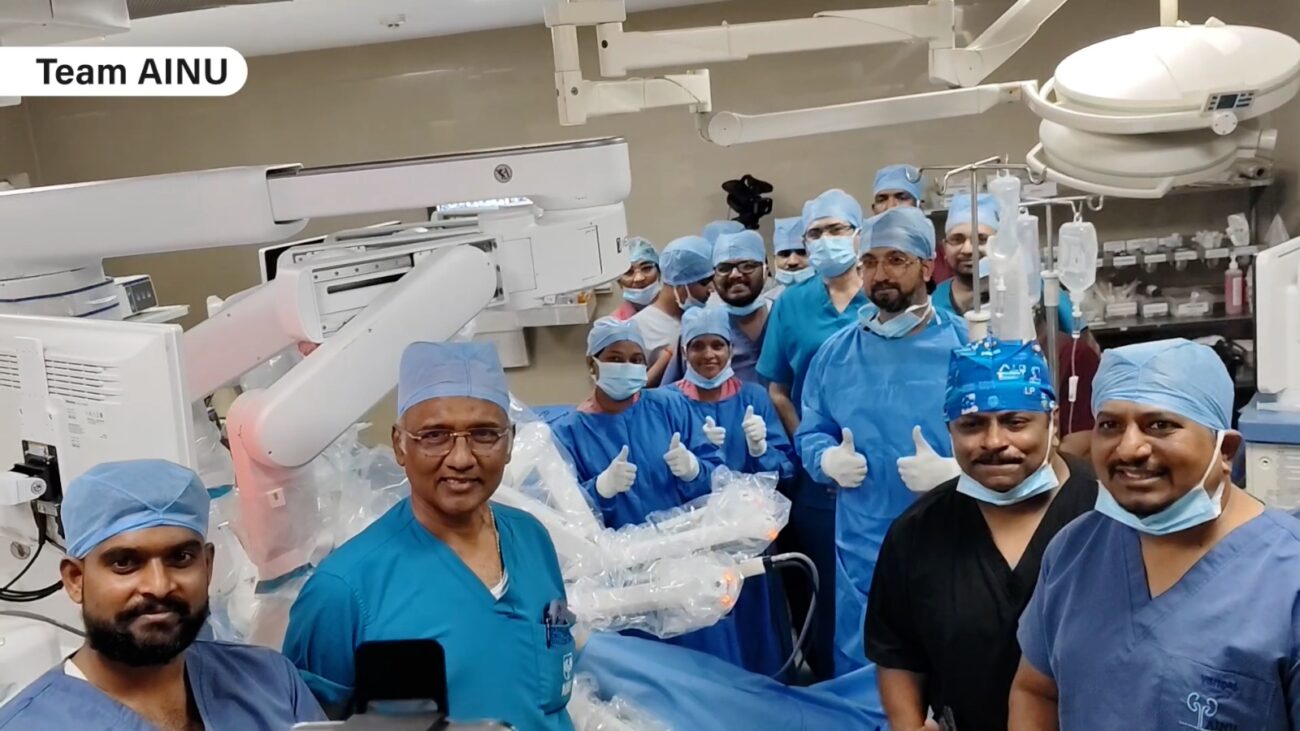
Dr. Syed Md. Ghouse, Director Robotic & Minimal Access Urological Surgery, AINU performed a
world-first tele-robotic ureteric reimplantation across nearly 3900 km (by air), connecting Wuhan,
China, with Hyderabad, India. The procedure marked a landmark collaboration between Tongji
Hospital and the Asian Institute of Nephrology and Urology (AINU). The 57-year-old patient from
Hyderabad suffered from recurrent ureteric obstruction due to a lower ureteric stricture. After
temporary relief with stenting, her symptoms returned, and further evaluation confirmed persistent
blockage. The surgical team performed an anti-reflux ureteric reimplantation to restore normal urine
flow. Using advanced robotic technology with less than 100 milliseconds latency, the surgery was
executed with real time precision. This breakthrough highlights the growing potential of cross
border robotic surgery to improve access to specialized care. The procedure was conducted with
patient consent and regulatory approval.
Speaking about the procedure, Dr. Mallikarjuna C, Managing Director, Chief Consultant Urologist &
Robotic Surgeon, AINU Banjara Hills, said, “Robotic surgery has transformed complex procedures by
enhancing precision and shortening the learning curve for surgeons. While access to technology is
improving, the real challenge lies in building skilled expertise. With advancements in 5G, tele
proctoring is emerging as the future, enabling experienced surgeons to guide teams remotely during
critical steps. This collaborative model ensures high quality care reaches patients closer to home,
without replacing the essential role of the on ground surgical team.”
Dr. Syed Md. Ghouse, Director Robotic & Minimal Access Urological Surgery AINU, who led the
procedure, said, “This milestone reflects how technology is redefining the boundaries of surgical
care. With robotic platforms and robust connectivity, we can now deliver highly specialized
procedures across continents with the same precision as being physically present. This is a significant
step towards equitable access to advanced cancer care”.
The complex urological procedure was conducted using a state-of-the-art robotic surgical system.
The patient was operated by a twin team of urosurgeons at the AINU Hospital in Hyderabad and
Tongji Hospital, China. Leveraging high speed, low latency connectivity and precision robotics, the
surgery was completed seamlessly, with real time control and zero perceptible delay. This milestone
highlights how cutting edge technology can bridge critical gaps in access to specialized surgical
care particularly for patients in remote or underserved regions who may otherwise face delays or
logistical challenges in receiving timely treatment.