
One Health Approach in India: Connecting Human, Animal and Environmental Health
Healthcare News Human health is closely connected to the health of animals and the environment. The spread of infectious diseases, increasing antimicrobial resistance and changing environmental conditions have made it clear that healthcare challenges cannot be

Human health is closely connected to the health of animals and the environment. The spread of infectious diseases, increasing antimicrobial resistance and changing environmental conditions have made it clear that healthcare challenges cannot be addressed by focusing only on people. Diseases can move between animals and humans, while environmental changes can create conditions that allow infections to spread more easily.
This is where the One Health approach in India becomes important. It promotes a coordinated system in which human healthcare professionals, veterinarians, environmental scientists, researchers and government authorities work together to prevent health threats and strengthen disease control.
India, with its large population, diverse animal species, extensive agricultural activities and rapidly changing urban environment, has a strong reason to adopt this integrated approach.
Understanding the One Health concept is essential for improving public health preparedness, controlling zoonotic diseases and building a more effective disease surveillance system. This article explores how India is developing its One Health strategy, why it matters and what challenges need attention.
What Is the One Health Concept?
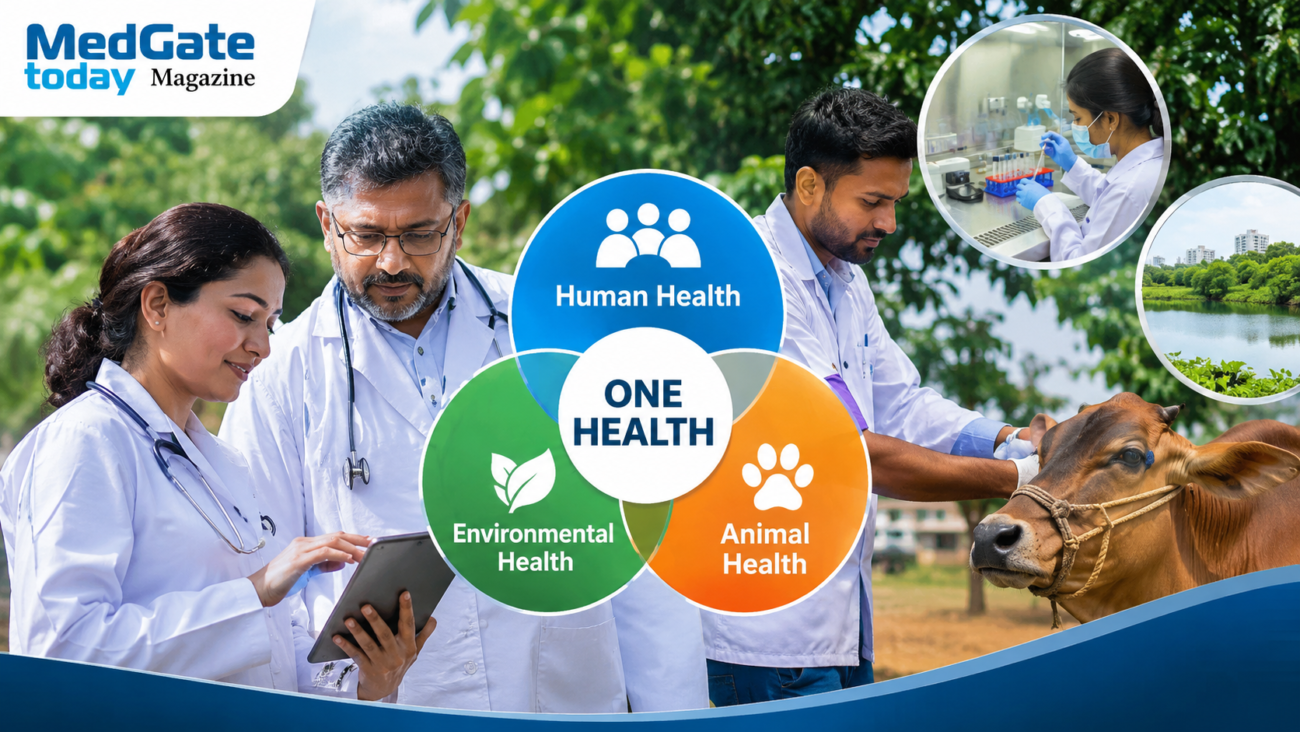
The One Health concept is an integrated approach that recognises the close relationship between human health, animal health and environmental health. It encourages different sectors to collaborate to prevent, detect and respond to health threats.
For example, an infectious disease may originate in animals and spread to humans through direct contact, contaminated food or environmental exposure. Similarly, pollution, deforestation and climate change can influence the spread of infections and affect the health of both humans and animals.
Instead of treating these problems separately, One Health promotes shared information, coordinated research and joint action.
The approach is particularly relevant because many emerging infectious diseases have an animal origin. According to international public health agencies, zoonotic diseases represent a significant proportion of emerging infectious disease threats worldwide.
Three Major Components of One Health
1. Human Health
This focuses on preventing diseases, improving healthcare services, strengthening laboratory testing and monitoring infections in communities. Hospitals, public health departments and medical research institutions play an important role.
2. Animal Health
Animal health professionals monitor infections in livestock, domestic animals and wildlife. Early identification of animal diseases can help prevent outbreaks before they spread to human populations.
3. Environmental Health
Environmental health focuses on factors such as water quality, sanitation, air pollution, biodiversity and climate conditions. Protecting ecosystems can reduce exposure to certain disease risks and support healthier communities.
Together, these three components form the foundation of the One Health approach in India.
Why Is the One Health Approach Important for India?
India faces several interconnected health challenges. Its population density, livestock sector, wildlife diversity and changing climate create conditions in which diseases can spread across different populations and environments.
A coordinated approach can help address these challenges more effectively.
1. Preventing Zoonotic Diseases in India
Zoonotic diseases are infections that spread between animals and humans. They can be caused by viruses, bacteria, parasites and fungi.
India faces several zoonotic disease threats, including rabies, leptospirosis, brucellosis, avian influenza and certain forms of viral encephalitis.
For instance, rabies remains an important public health concern, particularly in areas where access to timely vaccination and post-exposure treatment is limited.
Similarly, diseases associated with livestock and wildlife require regular monitoring and collaboration between veterinary and medical authorities.
The One Health approach in India can improve early detection by connecting animal disease reporting with human disease surveillance. This allows authorities to identify potential threats and respond before they develop into larger outbreaks.
2. Addressing Antimicrobial Resistance
Antimicrobial resistance (AMR) is another major reason why India needs a stronger One Health framework.
AMR occurs when bacteria, viruses, fungi or parasites develop the ability to resist medicines that previously worked against them. As a result, infections become more difficult to treat.
Antimicrobial resistance is not limited to hospitals. The use of antibiotics in livestock, poultry farming and other agricultural activities can also contribute to resistance when medicines are used improperly.
A coordinated strategy can help by promoting responsible antimicrobial use in hospitals, veterinary practices and agriculture.
It can also improve laboratory monitoring, strengthen infection prevention practices and encourage research into effective treatment options.
India’s National Action Plan on Antimicrobial Resistance provides an important policy foundation for addressing this challenge through a multisectoral approach.
3. Strengthening Disease Surveillance in India
Effective disease surveillance is essential for identifying emerging health threats.
Traditional surveillance systems often operate separately across human healthcare, veterinary services and environmental departments. This can create gaps in information sharing.
A stronger One Health system can connect these surveillance networks and improve communication between different authorities.
For example, an increase in unusual animal deaths in a particular region could provide an early warning of a potential infection risk. When this information is shared with public health authorities, appropriate testing and preventive measures can begin sooner.
Better disease surveillance in India can also support outbreak investigations, laboratory coordination and faster public health responses.
India’s One Health Strategy: Government Initiatives and Progress
India has increasingly recognised the importance of bringing different sectors together to address health threats.
One important development is the National One Health Mission, which aims to strengthen the country’s capacity to prevent, detect and respond to emerging health threats through coordinated efforts.
The mission is associated with the Office of the Principal Scientific Adviser to the Government of India and involves collaboration across multiple scientific and government institutions.
Its broader objective is to improve coordination between human health, animal health and environmental research systems.
Key Areas of India’s One Health Strategy
National One Health Mission
The mission provides a framework for bringing together institutions working in public health, veterinary science, research and related areas. It supports integrated preparedness and coordinated responses to emerging infectious diseases.
National Centre for Disease Control (NCDC)
NCDC plays an important role in disease surveillance, outbreak investigation and public health preparedness. Its work is relevant to strengthening India’s capacity to monitor and respond to infectious disease threats.
National Action Plan on Antimicrobial Resistance
India’s AMR action plan highlights the importance of responsible antimicrobial use, improved surveillance, infection prevention and collaboration across different sectors.
Research and Laboratory Collaboration
Research institutions and laboratories are important for identifying new pathogens, studying disease transmission and developing diagnostic capabilities. Better coordination can improve the country’s preparedness for future outbreaks.
These initiatives represent important steps towards building a more coordinated One Health system in India. However, effective implementation will require sustained funding, skilled professionals and stronger coordination at the state and district levels.
How One Health Can Improve India’s Public Health System
The One Health approach in India can deliver benefits beyond infectious disease prevention. It can improve several areas of healthcare and public health management.
Early Detection and Outbreak Prevention
When animal health and human health surveillance systems exchange information, authorities can identify unusual disease patterns earlier. This helps reduce delays in outbreak investigations and public health responses.
Better Preparedness for Emerging Infections
New infectious diseases can emerge when environmental conditions, animal populations and human activities interact. Joint research and monitoring can help identify potential risks and improve emergency preparedness.
Improved Food Safety
Contaminated meat, milk, eggs and other animal-derived products can expose people to harmful microorganisms. Cooperation between food safety authorities, veterinary services and public health departments can improve monitoring and reduce foodborne infections.
Protection of Environmental Health
Water contamination, poor sanitation, biodiversity loss and climate-related changes can influence disease patterns. Environmental monitoring should therefore be an important part of public health planning.
Stronger Healthcare Research
Collaboration between doctors, veterinarians, microbiologists, epidemiologists and environmental scientists can support better research and more effective solutions to complex health problems.
Major Challenges in Implementing One Health in India
Although the concept offers significant benefits, implementing it across a country as large and diverse as India is not simple.
Limited Coordination Between Departments
Human healthcare, veterinary services and environmental agencies often have separate administrative systems. Better coordination and clear responsibilities are necessary.
Gaps in Disease Surveillance
Some rural and remote regions have limited diagnostic facilities and reporting infrastructure. This can delay the identification of infections in animals and humans.
Shortage of Skilled Professionals
A successful One Health system requires trained professionals who understand epidemiology, veterinary medicine, microbiology, environmental science and public health.
Data Sharing and Laboratory Capacity
Different institutions may use separate reporting systems. Developing compatible data-sharing mechanisms and improving laboratory networks are essential.
Public Awareness
Farmers, animal handlers, healthcare workers and local communities need greater awareness of zoonotic infections, responsible antibiotic use, animal vaccination and environmental hygiene.
Addressing these challenges will require long-term investment, stronger institutional partnerships and active participation from local communities.
The Future of the One Health Approach in India
The future of One Health in India will depend on how effectively different sectors work together.
Technology can play an important role in this transformation. Digital disease reporting, laboratory information systems, geographic information systems and artificial intelligence can help identify unusual patterns and support faster decision-making.
However, technology alone cannot solve the problem. India also needs stronger veterinary infrastructure, accessible diagnostic facilities, trained healthcare professionals and consistent coordination between central and state authorities.
Greater collaboration with international organisations and research institutions can further strengthen disease preparedness.
The long-term success of the One Health approach in India will depend on turning policy commitments into practical action at the community level.
By connecting human and animal health with environmental protection, India can develop a more resilient public health system capable of addressing both existing and emerging health threats.
Frequently Asked Questions (FAQs)
1. What is the One Health approach in India?
The One Health approach in India is an integrated strategy that connects human health, animal health and environmental health. It promotes collaboration between government departments, healthcare professionals, veterinarians and researchers to prevent diseases and improve public health preparedness.
2. Why is One Health important for India?
One Health is important because India faces several health challenges, including zoonotic diseases, antimicrobial resistance, emerging infections and environmental health risks. A coordinated approach helps improve disease surveillance, early detection and outbreak management.
3. What are some examples of zoonotic diseases in India?
Examples include rabies, leptospirosis, brucellosis and avian influenza. These diseases can spread between animals and humans through different routes, depending on the infection.
4. What is the National One Health Mission?
The National One Health Mission is an Indian government initiative aimed at strengthening collaboration between different sectors and institutions to improve preparedness, surveillance and responses to emerging health threats.
5. How does One Health help control antimicrobial resistance?
One Health supports responsible antibiotic use across human healthcare, veterinary medicine and agriculture. It also promotes antimicrobial resistance surveillance, infection prevention, laboratory monitoring and coordinated research.
Conclusion
The connection between human health, animal health and environmental health cannot be ignored when addressing India’s growing public health challenges. From controlling zoonotic diseases to tackling antimicrobial resistance, an integrated approach is essential for building a stronger healthcare system.
The One Health approach in India offers an opportunity to improve disease surveillance, strengthen research collaboration and support better preparedness against emerging infections.
Government initiatives such as the National One Health Mission provide an important foundation, but their success will depend on effective implementation, public awareness and cooperation across sectors.
Disclaimer: This article is intended solely for general information and awareness and does not constitute professional advice, recommendation or endorsement; MedGate Today assumes no liability for decisions made based on its contents.